
Why Running Watts Are Not Enough
You did the math. Your window air conditioner draws 670W. Your power station is rated at 1,800W continuous. Plenty of headroom. You plug in, press the power button, and the station immediately trips and shuts off. No error message beyond a blinking red light.
The culprit is not running watts. It is the startup surge that every compressor, pump, and motor-driven appliance demands in the first fraction of a second after power is applied. That window AC does not gently ramp to 670W. It spikes to approximately 2,010W for 200 to 500 milliseconds while the compressor motor accelerates from a dead stop. If the power station’s peak (surge) rating cannot absorb that spike, the inverter’s overcurrent protection activates and the entire system goes dark.
If this just happened to you, the fix is straightforward: (1) find your device’s surge wattage — check the nameplate for LRA, or look it up in our compatibility calculator; (2) compare it to your station’s peak rating, not its continuous rating; (3) if the surge exceeds the peak, you need a larger station or a soft-start device to reduce the spike. The rest of this article explains why.
This distinction between running watts and surge watts is the single most misunderstood concept in portable power station sizing. Most product listings and comparison charts only show running watts. Our compatibility calculator evaluates both, and our True Surge Protocol explains exactly how we score each pairing. This article covers the physics behind the surge: why it happens, how large it gets, how to calculate it from a nameplate, and how to size a station so your equipment actually starts.
If you need a primer on watts versus watt-hours versus amps, start with our watts basics guide and come back here.
The Physics: Why Motors Surge
Think about riding a bicycle. The hardest moment is the very first pedal stroke from a dead stop. You stand on the pedals, push hard, and the bike barely moves. Once the wheels are turning, maintaining speed takes far less effort. The same principle governs every electric motor in your house.
An electric motor generates torque by passing current through copper windings inside a magnetic field. When the motor is spinning at operating speed, the rotation of the rotor through that magnetic field produces a voltage that opposes the supply voltage. This opposing voltage is called back-EMF (back electromotive force), and it is the electrical equivalent of the bicycle’s momentum. Back-EMF limits the current flowing through the windings, which is why a running motor draws moderate, predictable power.
At the instant of startup, the rotor is stationary. No rotation means no back-EMF. With nothing to oppose the supply voltage, current floods through the windings at their maximum rate, limited only by the copper’s resistance, which is very low. This is called the locked-rotor condition, and the current drawn during this state is the locked-rotor amperage, or LRA. For a typical single-phase compressor, LRA can reach three to six times the full-load amperage (FLA). Multiply LRA by voltage and you get the surge wattage.
The spike is brief. As the rotor accelerates, back-EMF builds, impedance rises, and current drops toward the running level. For most single-phase motors found in household appliances, this transition takes 100 to 500 milliseconds. But during that window, the power station’s inverter must sustain the full surge load. If it cannot, overcurrent protection trips before the motor ever reaches operating speed.
Motor Types and Their Surge Signatures
Not all motors surge equally. The type of motor inside a device determines how aggressively it pulls current at startup. Knowing which motor type your appliance uses lets you estimate surge behavior before you ever check a spec sheet.
PSC (Permanent Split Capacitor): 3-5x surge. Found in older window air conditioners and some ceiling fans. PSC motors use a single winding with a run capacitor. They have no start-assist mechanism, so the rotor must overcome inertia using the run winding alone. This produces a hard, sustained inrush. If your window AC was manufactured before roughly 2015, it almost certainly uses a PSC compressor.
CSIR (Capacitor Start, Induction Run): 4-6x surge. The workhorses of residential compressors. Found in refrigerators, sump pumps, well pumps, and most pancake air compressors. A start capacitor provides an initial torque boost, but inrush current remains high because the motor still relies on brute electromagnetic force to accelerate a heavy compressor mechanism. The CRAFTSMAN CMEC6150 pancake compressor is a CSIR motor. Its 5.15x surge ratio is not an outlier for this motor class.
Inverter-driven (BLDC/VFD): 1.0-1.5x surge. Found in modern inverter air conditioners, high-end refrigerators with linear compressors, and cordless power tools. An electronic controller ramps current gradually from zero to operating level, eliminating the inrush spike almost entirely. This is why an inverter mini-split rated at 1,200W running can start on a power station that would trip immediately with a PSC window unit of the same wattage.
Universal motor: 2-3x surge. Found in corded power tools (circular saws, drills, routers, vacuums). These brushed motors produce moderate inrush because their series-wound design provides some inherent current limiting. The surge is real but shorter and lower than a compressor.
Shaded-pole: 1.5-2x surge. Found in small fans, microwave turntable motors, and bathroom exhaust fans. These low-torque motors have minimal startup demands and rarely present a sizing challenge.
Load Profiles: Surge by Device Category
Our database tracks 49 devices across six load profiles. Each profile carries a different surge behavior and a different safety buffer in our compatibility engine.
Resistive (1.0x surge, +10% buffer). Space heater, electric kettle, toaster oven. No motor, no surge. Current at startup equals current at steady state. The 10% buffer accounts for minor voltage fluctuations and manufacturing tolerances.
Heating element (1.0x surge, +10% buffer). Microwave magnetron, electric oven, clothes dryer heating coil. Like resistive loads, these generate no meaningful inrush. The buffer matches resistive.
Electronic (1.0-1.3x surge, +15% buffer). Laptop, TV, router, gaming PC. Electronics contain capacitors that draw a brief inrush as they charge, but the spike is small (typically under 1.3x) and lasts only a few milliseconds. The 15% buffer accounts for multiple devices drawing capacitor inrush simultaneously.
Motor (3.0x surge, +15% buffer). Corded drills, circular saws, fans, shop vacs. The NEC uses 3.0x as a baseline multiplier for motor-driven loads without specific nameplate data. Real-world values vary by motor type (see the section above), but 3.0x is a safe starting point for universal motors.
Medical (variable surge, +15% buffer). CPAP machines, nebulizers, oxygen concentrators. Surge behavior depends entirely on the specific device. A ResMed AirSense 10 CPAP draws just 53W running and 104W peak (1.96x), while some oxygen concentrators can surge to 600W or more. We source every medical device’s surge from OEM documentation, never from generic estimates. The 15% buffer reflects the critical nature of these loads.
Compressor (3.0-5.3x surge, +25% buffer). Refrigerator, air conditioner, sump pump, air compressor. This category gets the largest buffer for a specific reason.
Real OEM Surge Data
Theory is useful. Data is what sizes a power station. The table below shows running watts, surge watts, and the surge-to-running ratio for eight devices from our database, all sourced from OEM specifications or NEC tables.
Highest ratio in this sample: Central AC (3-Ton) at 5.26x.
| Device | Running | Surge | Ratio |
|---|---|---|---|
| Air Compressor (Pancake) | 1,620W | 8,343W | 5.15x |
| Central AC (3-Ton) | 4,060W | 21,356W | 5.26x |
| Well Pump (1 HP) | 2,392W | 7,176W | 3.00x |
| Sump Pump (1/2 HP) | 1,127W | 3,381W | 3.00x |
| Window AC (8,000 BTU) | 670W | 2,010W | 3.00x |
| French Door Refrigerator | 207W | 414W | 2.00x |
| Circular Saw (Corded) | 1,800W | 5,400W | 3.00x |
| Space Heater (1,500W) | 1,500W | 1,500W | 1.00x |
Air Compressor (Pancake)
- Running
- 1,620W
- Surge
- 8,343W
- Ratio
- 5.15x
Central AC (3-Ton)
- Running
- 4,060W
- Surge
- 21,356W
- Ratio
- 5.26x
Well Pump (1 HP)
- Running
- 2,392W
- Surge
- 7,176W
- Ratio
- 3.00x
Sump Pump (1/2 HP)
- Running
- 1,127W
- Surge
- 3,381W
- Ratio
- 3.00x
Window AC (8,000 BTU)
- Running
- 670W
- Surge
- 2,010W
- Ratio
- 3.00x
French Door Refrigerator
- Running
- 207W
- Surge
- 414W
- Ratio
- 2.00x
Circular Saw (Corded)
- Running
- 1,800W
- Surge
- 5,400W
- Ratio
- 3.00x
Space Heater (1,500W)
- Running
- 1,500W
- Surge
- 1,500W
- Ratio
- 1.00x
A few things stand out. The central AC at 5.26x and the pancake air compressor at 5.15x are not anomalies. They are normal behavior for CSIR compressor motors. The NEC’s default 3.0x multiplier for motor loads is a floor, not a ceiling, and any sizing approach built on a blanket “assume 3x” rule will undersize for the majority of compressor-driven appliances.
At the other end of the spectrum, devices with no motor produce no surge at all. A 1,500W space heater and a 1,500W electric kettle both carry a 1.00x ratio. Their full-load draw is their peak draw.
Beyond the eight devices in the table, here are four additional data points from our database that illustrate the full range:
CPAP Machine (ResMed AirSense 10): 53W running, 104W peak, 1.96x. OEM-sourced from the ResMed battery guide. The “surge” here is a pressure ramp at therapy start, not a motor inrush. Any station above 150W handles this comfortably.
Gaming Laptop: 350W running, 455W peak, 1.30x. The spike comes from capacitor inrush in the power supply, not a motor. Brief and small.
Router plus Modem: 25W running, 33W peak, 1.30x. Same capacitor inrush behavior. Negligible in any sizing calculation.
Electric Kettle: 1,500W running, 1,500W peak, 1.00x. Pure resistive load. Zero surge.
For device-specific surge calculations using your own nameplate data, use our LRA calculator. For pre-calculated compatibility verdicts, check our best-for pages.
How to Read LRA on a Nameplate
If a device has a motor, you need its locked-rotor amperage (LRA) to calculate surge. Here is where to find it, in order of reliability:
- Best: LRA printed on the nameplate. Use it directly.
- Good: LRA in the installation manual or spec sheet. Same formula, same accuracy.
- Fallback: estimate from HP and code letter (NEC 430.7(B)). Only when the above are unavailable.
Once you have the LRA, the conversion is direct:
Single-phase surge from LRA
Surge watts = LRA × Voltage
A sump pump nameplate showing 29.4 LRA at 115V produces a surge of 29.4 × 115 = 3,381W. That matches our calculated surge figure for a 1/2 HP sump pump (LRA × voltage, sourced from the manufacturer installation manual).
When LRA is not printed directly on the nameplate, you can derive it from the motor’s code letter using NEC Table 430.7(B) (NEC tables are the standard reference electricians use for motor sizing calculations). The code letter corresponds to a range of kilovolt-amperes per horsepower at locked rotor. The formula becomes:
LRA from NEC code letter (single-phase)
LRA = (kVA per HP × HP × 1,000) / Voltage
For example, a 1 HP well pump with a code letter indicating 6.2 kVA/HP at 115V: LRA = (6.2 × 1 × 1,000) / 115 = 53.9 amps. Surge watts = 53.9 × 115 = 6,200W. In practice, you would use the higher end of the kVA range for the assigned code letter to ensure conservative sizing.
Three common mistakes people make when reading nameplates:
Confusing FLA with LRA. Full-Load Amperage (FLA) is the running current. Locked-Rotor Amperage (LRA) is the startup current. They can differ by a factor of five or more. FLA tells you sustained draw. LRA tells you whether the device will start. If a spec sheet shows only one amperage number, it is almost always FLA, and you must calculate or look up the LRA separately.
Using circuit breaker rating as device draw. A device plugged into a 15-amp circuit does not draw 15 amps. The breaker rating is the maximum the circuit can safely deliver, not the load the device imposes. A refrigerator on a 15-amp circuit might draw only 1.8 amps while running. Sizing a power station to the breaker rating rather than the device rating leads to expensive oversizing.
Ignoring the difference between VA and watts. Technically, LRA multiplied by voltage gives volt-amperes (VA), not true watts, because motor power factor at startup is low (typically 0.2 to 0.4). However, using VA for sizing is conservative: the actual watt demand is lower than VA, so a station that can supply the VA figure can certainly supply the true wattage. For portable power station sizing, treating VA as watts provides a safe margin.
Use our LRA-to-surge calculator to run these conversions instantly.
The Worst-Case Startup Moment
In a real power outage, you will not run one device at a time. The refrigerator will be cycling. Lights will be on. Phones will be charging. The critical sizing moment is not any single device running. It is the instant when the highest-surge device starts while everything else is already drawing power.
Worst-case startup moment
Pump starts while fridge, lights, and laptop are running
Can your power station handle it?
With 25% compressor buffer: 3,681W × 1.25 = 4,602W recommended surge capacity.
Consider this scenario: a refrigerator running at 150W, a few LED lights drawing 50W, and a laptop plus phone charger at 100W. The total baseline load is 300W. Then the sump pump kicks on during a rainstorm. The pump surges to 3,381W at startup, on top of the 300W already flowing. Total peak demand at that moment: 3,681W.
With the 25% compressor buffer applied to the sump pump’s surge (because it will cycle repeatedly, and hot restarts draw more current), the recommended station capacity becomes 3,681 × 1.25 = 4,602W peak.
A power station rated at 2,400W peak fails this scenario. A station rated at 4,800W peak passes with margin. This is the difference between an outage where your basement floods and one where it does not. Our full sizing guide walks through this calculation step by step for your specific device list.
Sizing a Station by Surge Class
Not every household needs a station that can handle a 3-ton central AC (21,356W surge). The right station depends on which surge class your heaviest device falls into.
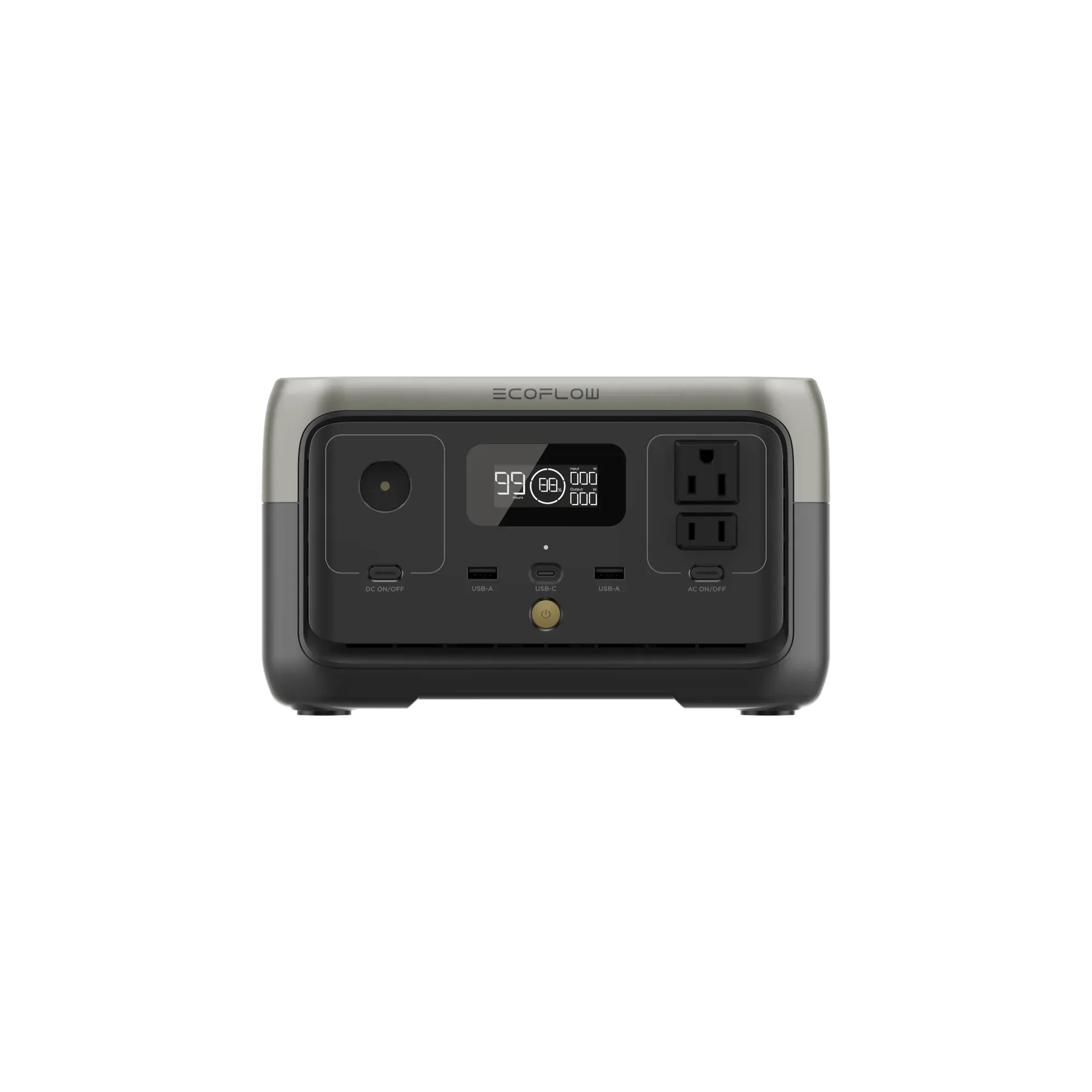
At 300W continuous and 600W surge, the RIVER 2 handles every device with a 1.0x to 1.3x surge ratio: laptops, phones, routers, LED lights, and medical devices like a CPAP machine. It cannot start anything with a compressor or a motor. Think of it as a dedicated electronics and medical backup.
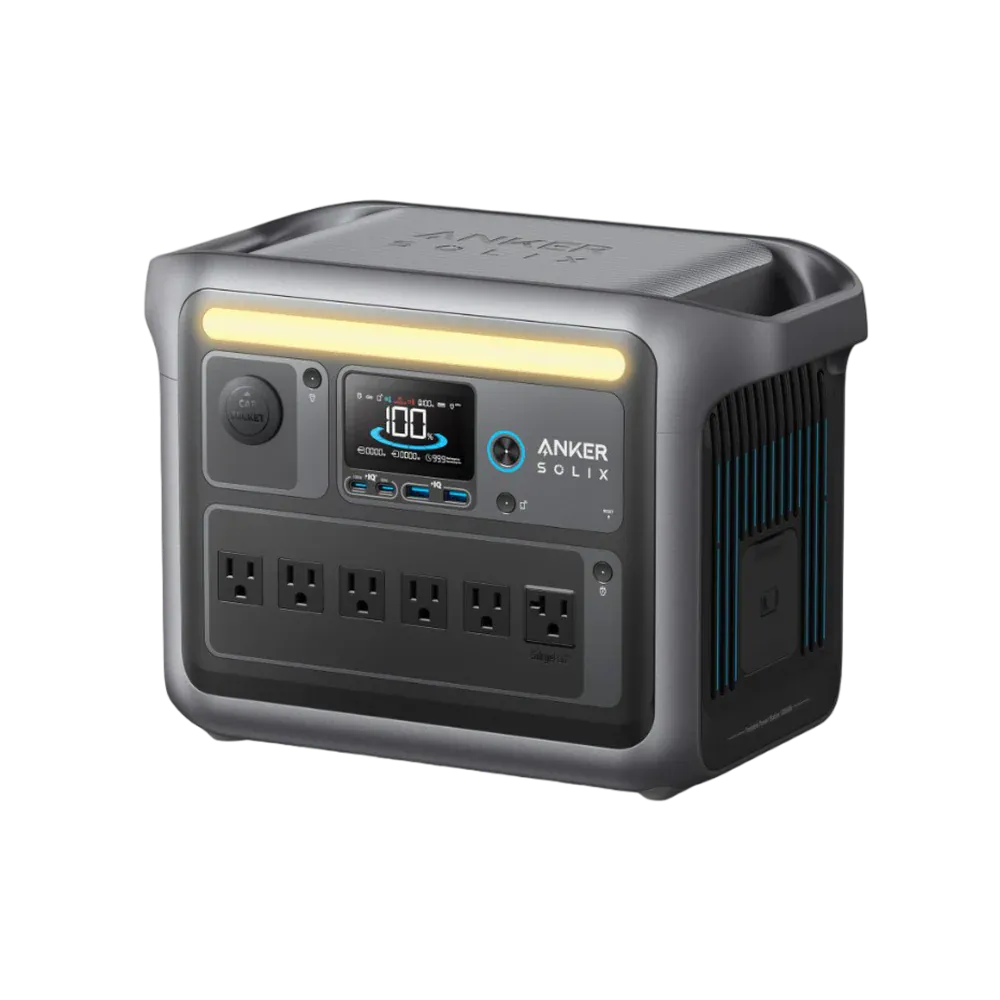
At 1,800W continuous and 2,400W surge, the C1000 handles all resistive loads (space heater, electric kettle) and small motor-driven devices. A window AC at 2,010W surge falls within its peak rating, but with the 25% compressor buffer applied, the effective requirement rises to 2,513W, which exceeds the C1000’s capacity. A soft-start device reduces the AC’s inrush by up to 55%, bringing it within range.
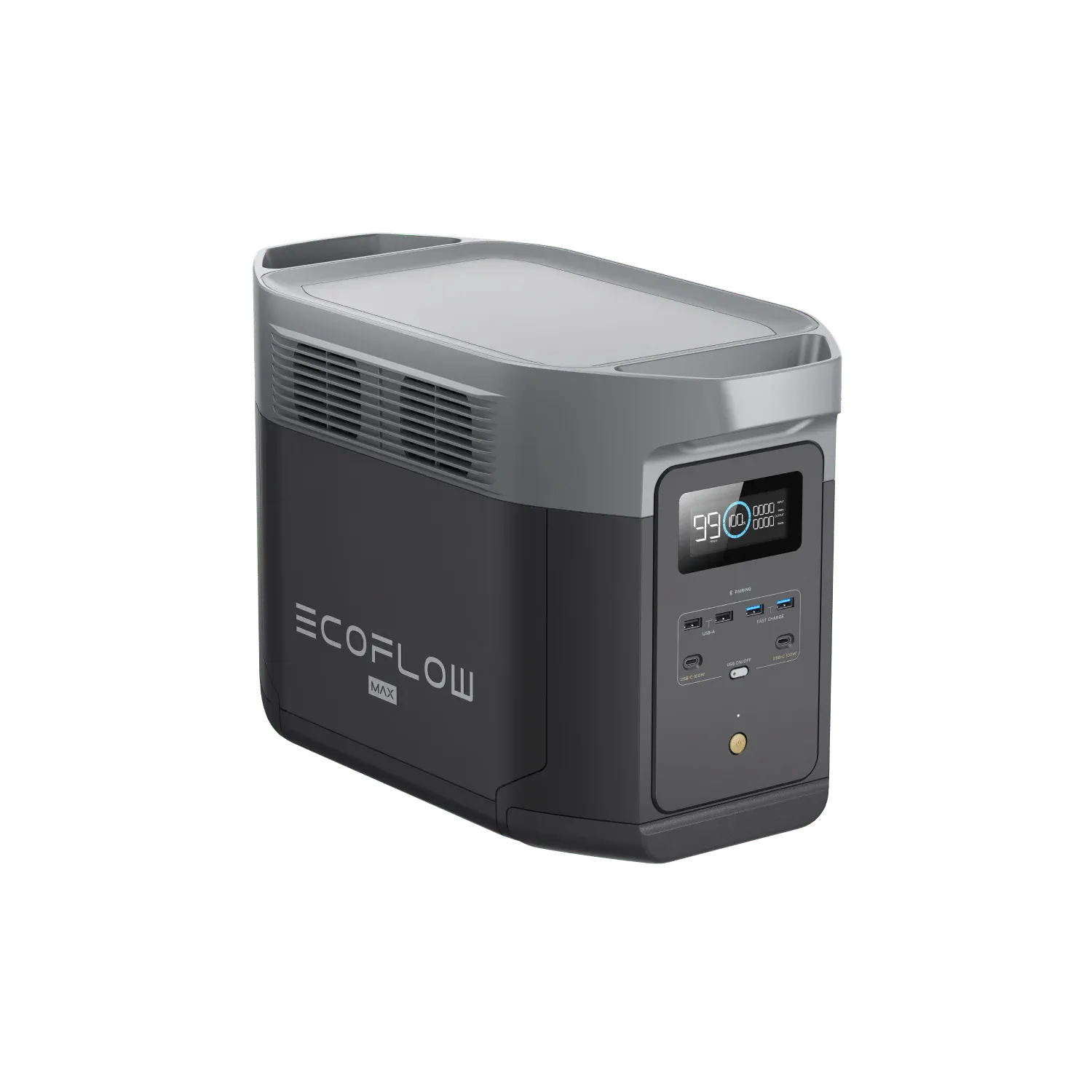
At 2,400W continuous and 4,800W surge, the DELTA 2 Max handles most 120V motor and compressor loads, including the window AC (2,010W surge), the sump pump (3,381W surge), and the portable AC (4,071W surge). It covers the worst-case overlap scenario described above (3,681W peak, 4,602W buffered) with a thin margin. For the majority of households that need to run a refrigerator, sump pump, and a few electronics during an outage, this is the practical sweet spot.
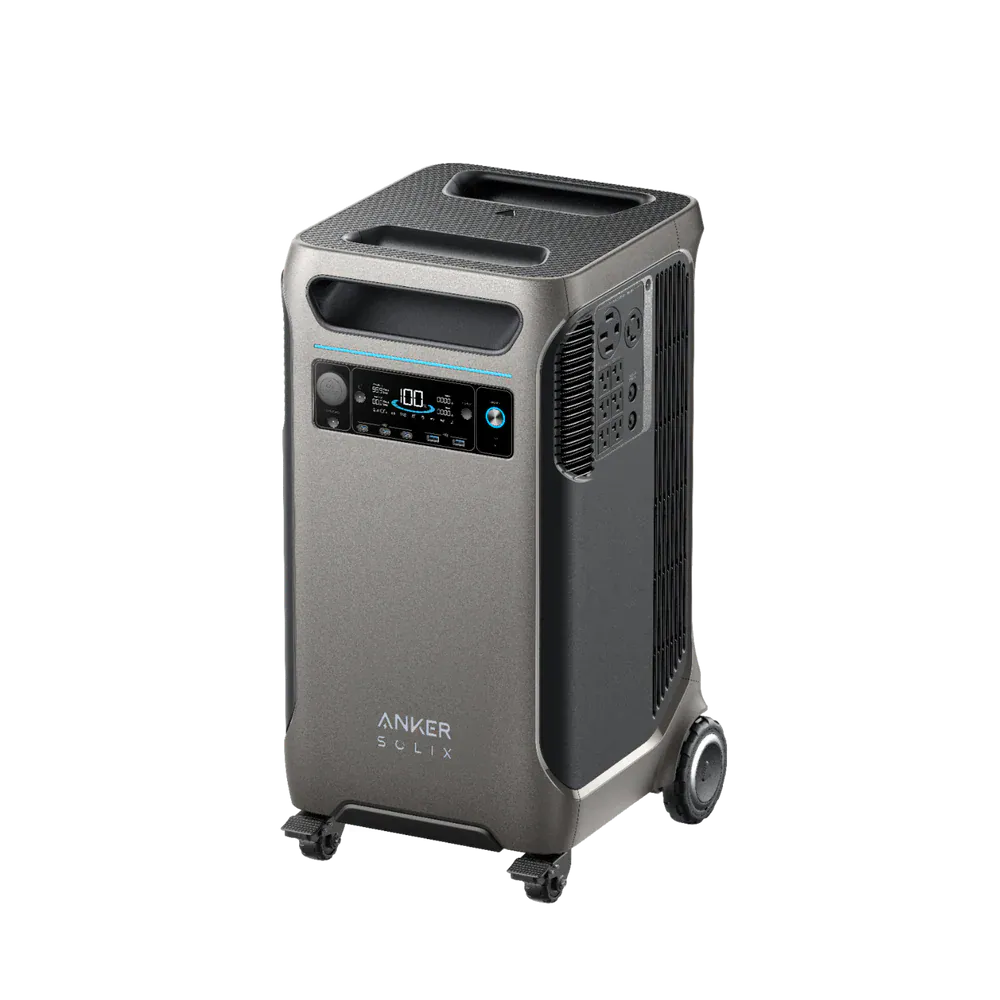
Anker Anker SOLIX F3800
At 6,000W continuous and 9,000W surge, the F3800 handles the heaviest 120V loads including the pancake air compressor (8,343W surge) and well pumps. It also supports 240V output, opening the door to central AC systems (with limitations) and Level 2 EV charging. For jobsite contractors who need to start a compressor and a circular saw on the same circuit, or homeowners with a well pump, this is the minimum viable option. See our best stations for air compressor page for detailed compatibility results.
Limitations and Edge Cases
Surge physics is not perfectly predictable, and there are several factors that published specifications do not capture. Understanding these limitations separates competent sizing from guesswork.
Peak duration versus inverter tolerance. A power station may spec “6,000W peak,” but the datasheet rarely says for how long. Some inverters sustain peak for only 5 to 10 milliseconds. A CSIR compressor motor may need 200 to 500 milliseconds to accelerate past the inrush window. If the inverter drops out of peak mode before the motor reaches speed, the station trips even though its peak rating numerically exceeds the device’s surge. Almost no portable power station manufacturer publishes peak duration specs, which is one reason our compatibility engine applies safety buffers rather than relying on exact numerical matches.
VA versus watts and power factor. Startup power factor is low (0.2 to 0.4), meaning actual watt demand at startup is lower than the VA figure from LRA x voltage. Using VA for sizing is intentionally conservative. Some competing tools divide by an assumed power factor to derive “true surge watts,” yielding a tighter margin. We use the full VA figure because undersizing (inverter trip, device failure to start) is worse than modestly oversizing.
Temperature and altitude. Cold temperatures reduce motor winding impedance, slightly increasing inrush current. A compressor starting at 20 degrees Fahrenheit draws more surge than the same unit starting at 70 degrees. Higher altitudes impair motor cooling, producing a similar effect. Neither factor changes the surge class of a device, but both can push a borderline pairing from SAFE to FAIL.
Battery state of charge. Inverter peak output degrades as the battery depletes. A station rated at 4,800W peak at full charge may deliver only 3,800W at 20% state of charge. A pairing that passes at 80% SOC may trip at 20% SOC. This is another reason our compatibility engine applies buffers: they account for real-world SOC variation, not just best-case conditions.
Harmonic distortion and waveform quality. All four stations listed above produce a pure sine wave, which is what motor-driven devices expect. Modified sine wave inverters, found in cheaper power stations and car inverters, produce a stepped waveform rich in harmonics. These harmonics increase motor heating and can elevate inrush current beyond pure sine wave calculations. If you are using a modified sine wave source, add 15 to 20% to your surge estimates or upgrade to a pure sine wave station.
Key Takeaways
Surge watts, not running watts, decide whether a device starts. Running watts decide whether it stays on. Most overload trips happen at startup, not during steady-state operation.
Compressors and motors surge 3.0x to 5.3x their running wattage. Resistive loads produce no surge (1.0x). Electronics fall in between at 1.0 to 1.3x.
Always check the power station’s peak (surge) rating, not just continuous. A station rated at 2,400W continuous with 4,800W peak handles a fundamentally different set of devices than one with only 3,000W peak.
Apply safety buffers by load profile: 10% for resistive, 15% for motors and electronics, 25% for compressors. These account for cycling, hot restarts, SOC degradation, and temperature.
For multi-device scenarios, calculate worst-case overlap: total running watts of all devices plus the full surge of the highest-surge device starting simultaneously.
Use our compatibility calculator for instant results, or follow the step-by-step process in our full sizing guide.
Sources and Standards
All device surge data in this article originates from the following hierarchy:
- OEM-published specifications. Manufacturer support documentation and product pages. CRAFTSMAN CMEC6150 starting/running watts (OEM support page), ResMed AirSense 10 power specifications (OEM battery guide), Frigidaire FHWC084WB1 (OEM product page, 670W at 5.9A, 115V).
- NEC 2023 standards. Article 430 (Motors, Motor Circuits, and Controllers), Table 430.248 (Full-Load Currents, Single-Phase AC Motors), Table 430.7(B) (Locked-Rotor Code Letters). Article 440 covers AC and refrigeration equipment.
- ENERGY STAR database. Annual energy consumption data for appliances like the LG LMXS28596S (724 kWh/year).
- Engineering estimates. NEC-derived multipliers (3.0x for motors, variable for compressors) applied when OEM surge data is unavailable, with clearly labeled source attribution.
For a complete explanation of how we rank and verify data sources, see our methodology page.