
Why RV Rooftop AC Is the Hardest Load
You pull into a desert boondocking spot at 105 degrees. The interior of your RV is already at 95 and climbing. You press the thermostat. The compressor clicks on, draws a massive slug of current for half a second, and your power station shuts off.
This is the most common complaint from RV owners who try to run their rooftop AC on a portable power station. The problem is not running watts. Most mid-range stations can sustain 1,500 to 1,800W indefinitely. The problem is surge: RV rooftop ACs use PSC-type compressors that draw 3 to 5 times their running current during startup. That spike lasts only 100 to 500 milliseconds, but it exceeds the peak rating of most portable power stations.
This is not the same challenge as running a window AC or a portable AC. Those units use smaller compressors with lower locked rotor amps. A typical 8,000 BTU window AC surges to 2,010W. A 13,500 BTU RV rooftop unit can surge to 8,856W. The gap between running watts and surge watts is the widest of any common RV device, and it defines the entire sizing conversation.
Three RV AC Models Compared
Not all rooftop ACs are equal. Surge varies significantly by manufacturer and model, and the source of the surge data matters.
| Model | Running W | Surge W | Surge Ratio | Source |
|---|---|---|---|---|
| Dometic Brisk II B57915.71X | 1,788 | 8,856 | 4.95× | OEM manual (LRA: 68.0A + 5.8A fan) |
| Airxcel Mach 10 45203 | 1,450 | 7,245 | 5.00× | OEM manual (compressor LRA: 63A) |
| Coleman-Mach 8 Plus | 1,633 | 4,899 | 3.00× | OEM page (14.2A @ 115V, surge 3× NEC) |
The Dometic Brisk II and Airxcel Mach 10 both publish locked rotor amps in their installation manuals, so we can calculate exact surge wattage. The Dometic’s 68.0A compressor LRA plus 5.8A fan LRA at 120V yields 8,856W. The Airxcel’s 63A compressor LRA at 115V yields 7,245W. These are derived numbers, not estimates. Use our LRA-to-surge calculator to run the math on any motor.
The Coleman-Mach 8 Plus does not publish LRA. For this unit, we apply the NEC Article 440 standard of 3× running amps as a conservative floor: 14.2A × 115V × 3 = 4,899W.
The Soft-Start Solution
A soft-start module changes the startup physics. Instead of the compressor seeing full line voltage the instant the contactor closes, an SCR circuit ramps voltage from near-zero to full over 1 to 3 seconds. The motor accelerates gradually. Inrush current stays bounded.
The Micro-Air EasyStart 364 is the industry standard for RV rooftop AC soft-start. It installs inside the AC unit’s electrical compartment (not inline between the station and the power cord), wiring across the compressor’s start and common terminals. Installation takes 15 to 30 minutes for a confident DIYer or under 15 minutes for an RV technician. For the full physics of how soft-starters work across all device types, see our soft-start guide.
Soft-start surge reduction
Reduced surge = Raw surge × 0.45
For the Dometic Brisk II: 8,856 × 0.45 = 3,985W soft-started surge. With our 25% compressor buffer: 3,985 × 1.25 = 4,981W recommended station peak.
That 0.45 factor is our conservative modeling assumption. Micro-Air claims 65 to 75% reduction (a 0.25 to 0.35 factor). We use 55% reduction because actual performance varies with installation quality, ambient temperature, refrigerant pressure, and compressor age. A station rated at 4,981W peak or higher gives margin for conditions worse than ideal.
Soft-start surge reduction
Dometic Brisk II B57915.71X (13,500 BTU) at startup
With 25% compressor buffer: 3,985W × 1.25 = 4,981W recommended station peak.
Can these stations handle it with soft-start?
Which Power Stations Work
We divide the 33 stations in our database into three tiers based on their ability to handle the Dometic Brisk II, the worst-case model.
Tier 1: Handles raw surge without soft-start. These stations have enough peak capacity to absorb the full 8,856W startup spike. No additional hardware needed.
| Station | Running W | Surge W | Capacity |
|---|---|---|---|
| EcoFlow DELTA Pro Ultra X | 12,000 | 24,000 | 6,144 Wh |
| EcoFlow DELTA Pro Ultra | 6,000 | 12,000 | 6,144 Wh |
| Anker SOLIX F3800 | 6,000 | 9,000 | 3,840 Wh |
Only 3 of 33 stations clear the Dometic’s raw surge. These are the heavy-duty, whole-home class units. If you want to avoid installing a soft-start module entirely, this is the tier.
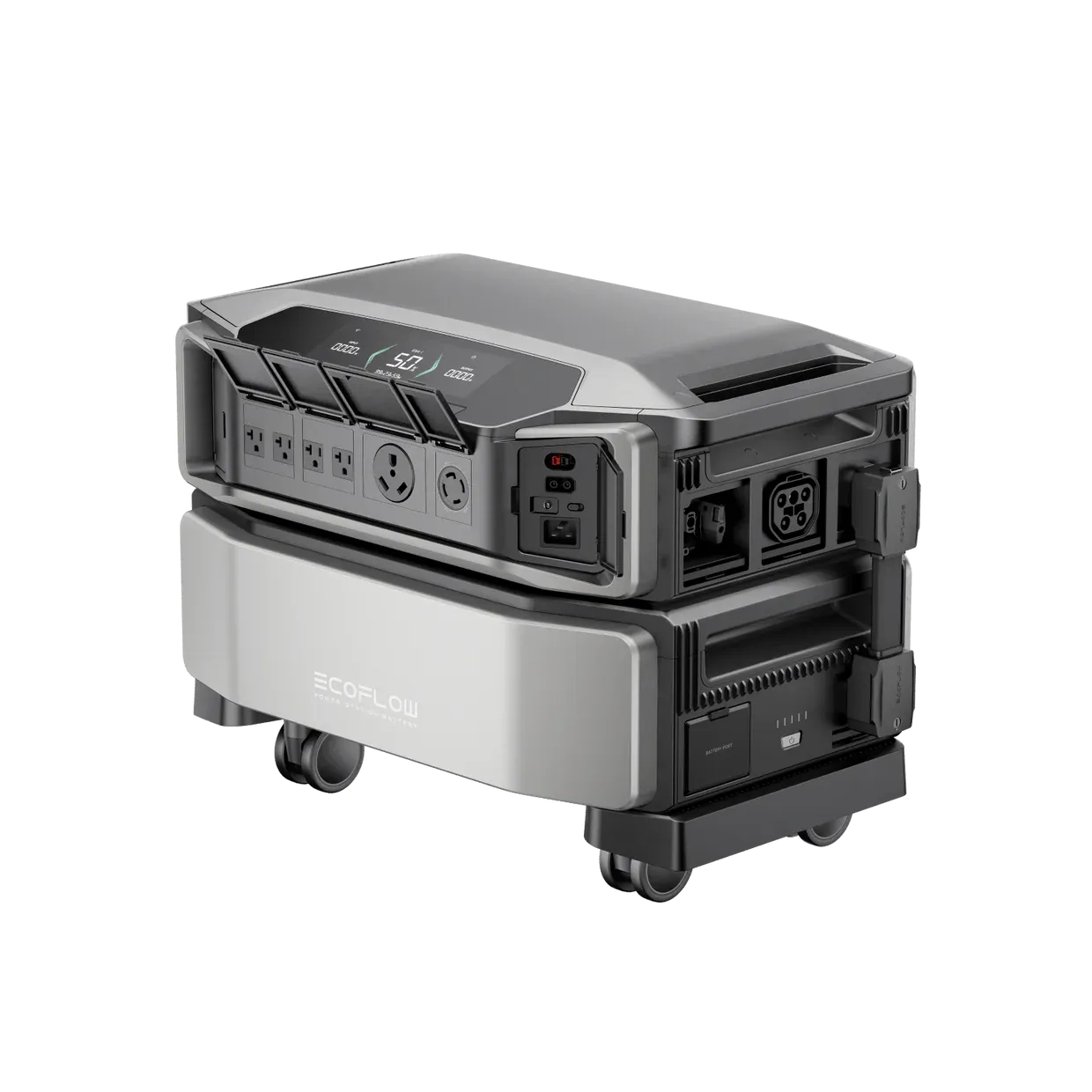
EcoFlow Delta Pro Ultra
6,000W continuous, 12,000W surge, 6,144 Wh. The DELTA Pro Ultra handles the Dometic’s 8,856W raw surge with 35% headroom. It also provides the largest battery in this tier, delivering the longest runtime per charge. The trade-off is price and weight. For a broader comparison of RV-suitable stations, see our RV camping buying guide.
Tier 2: Viable with soft-start module. With a Micro-Air EasyStart 364 installed, the reduced surge (3,985W, buffered to 4,981W) falls within these stations’ peak ratings.
| Station | Running W | Surge W | Capacity | Verdict with Soft-Start |
|---|---|---|---|---|
| EcoFlow DELTA Pro 3 | 4,000 | 8,000 | 4,096 Wh | Eligible (8,000W > 4,981W) |
| Pecron E3600LFP | 3,600 | 7,000 | 3,072 Wh | Eligible (7,000W > 4,981W) |
These mid-range stations cannot handle the raw 8,856W spike, but with soft-start reducing it to 3,985W (buffered to 4,981W), their peak ratings clear the threshold. The DELTA Pro 3 at 8,000W peak has the most headroom in this tier. The Pecron E3600LFP at 7,000W peak also clears comfortably. For most boondockers, Tier 2 plus a soft-start module is the practical sweet spot: less expensive than Tier 1, and the soft-start module is a modest one-time addition.
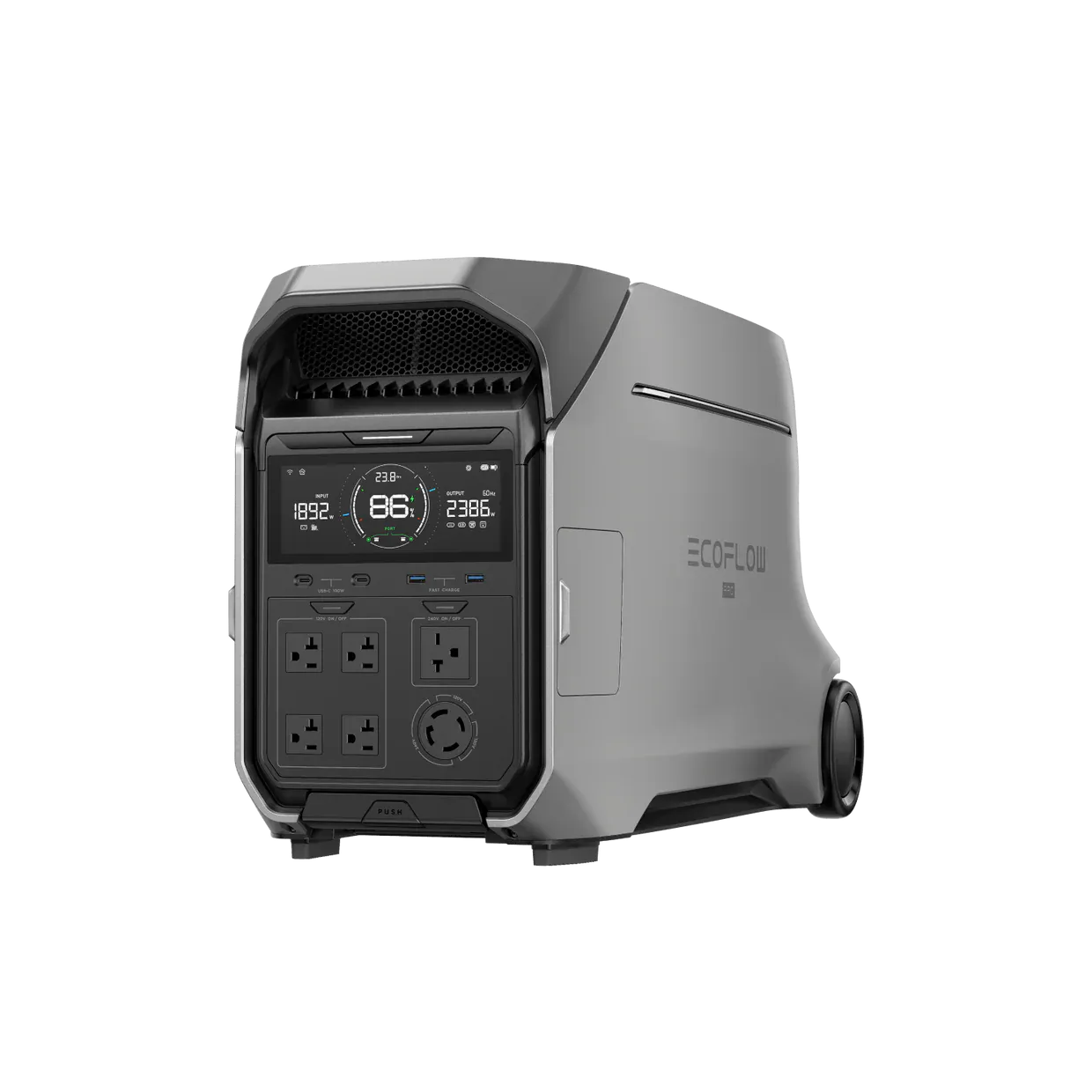
EcoFlow DELTA Pro 3
4,000W continuous, 8,000W surge, 4,096 Wh. The DELTA Pro 3 pairs naturally with a soft-start module. Its 8,000W peak is 60% above the 4,981W buffered threshold. Its 4,000W continuous output sustains the Dometic’s 1,788W running draw with comfortable margin for the condenser fan and any simultaneous 12V loads in the RV. It also accepts up to 1,600W of solar input for extended runtime.
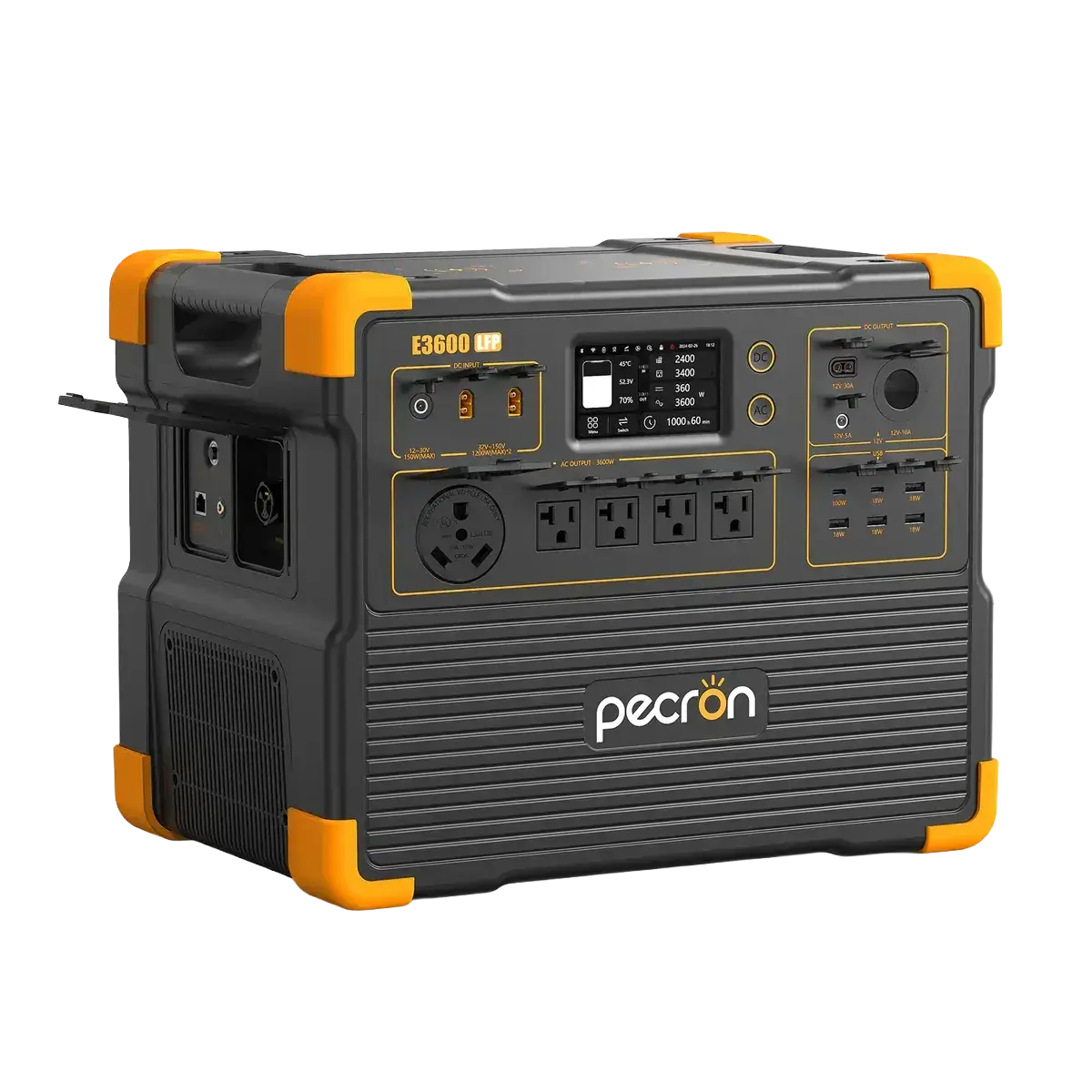
3,600W continuous, 7,000W surge, 3,072 Wh. The Pecron E3600LFP offers a lower price point for boondockers on a budget. Its 7,000W peak clears the 4,981W buffered threshold with soft-start. The 3,600W continuous output sustains the Dometic’s 1,788W draw, though with less margin than the DELTA Pro 3. Smaller battery capacity means shorter runtime (1.2 hours vs 1.6 hours at 1,788W draw).
Tier 3: Fails even with soft-start. These stations fall short on surge, running watts, or both.
| Station | Running W | Surge W | Why It Fails |
|---|---|---|---|
| Bluetti AC200L | 2,400 | 3,600 | 3,600W peak below 4,981W buffered threshold |
| Jackery Explorer 2000 v2 | 2,200 | 4,400 | 4,400W peak below 4,981W buffered threshold |
| Bluetti AC200MAX | 2,200 | 4,800 | Running watts (2,200W) leave no buffer for 1,788W sustained draw |
Runtime Reality Check
Passing the surge test is necessary but not sufficient. The next question is: how long will the battery last?
AC runtime estimate
Runtime (hours) = (Capacity × 0.70) / Running watts
The 0.70 factor accounts for inverter efficiency losses between DC storage and AC output.
| Station | Usable Wh (× 0.70) | Runtime at 1,788W | Runtime at 1,450W |
|---|---|---|---|
| EcoFlow DELTA Pro Ultra (6,144 Wh) | 4,301 | 2.4 hours | 3.0 hours |
| EcoFlow DELTA Pro 3 (4,096 Wh) | 2,867 | 1.6 hours | 2.0 hours |
| Pecron E3600LFP (3,072 Wh) | 2,150 | 1.2 hours | 1.5 hours |
These numbers assume continuous compressor operation. Real-world duty cycle helps: the compressor cycles off when the RV reaches target temperature. In mild conditions (85 degrees outside, well-insulated RV), duty cycle might be 50%, roughly doubling the effective runtime. In extreme heat (105 degrees, poor insulation), duty cycle approaches 80 to 90%, and the runtime gains are minimal.
Solar Recharging While Running AC
Can you run the AC and recharge the battery simultaneously? Yes, but the math rarely breaks even.
The Dometic Brisk II draws 1,788W. If you have 800W of solar panels on the roof feeding the DELTA Pro 3 (1,600W max solar input), and conditions are favorable (Arizona sun, 5 peak sun hours), the effective harvest after panel derate is roughly 800 × 0.70 = 560W. Net battery drain: 1,788 minus 560 = 1,228W. The battery still depletes, but at 69% of the rate it would without solar.
With 560W of effective solar offset, the DELTA Pro 3’s runtime extends from 1.6 hours to approximately 2,867 / 1,228 = 2.3 hours. That is a meaningful gain, but it does not approach indefinite operation.
For a complete analysis of solar panel sizing and charge time estimation, see our solar panel guide and solar charge time calculator.
The practical takeaway: solar extends your cooling windows but does not eliminate the time limit. Plan your heaviest AC use for peak solar hours when the offset is greatest. For a full walkthrough of sizing solar and battery capacity for extended off-grid stays, see our boondocking solar and battery sizing guide.
Alternatives If Your Station Cannot Handle It
If your power station falls into Tier 3, three alternatives exist that require less peak capacity.
Portable AC unit (12,000 BTU). Running watts: 1,357W. Surge: 4,071W. The surge ratio is lower than a rooftop unit, and many more stations can handle it. The downside is that a portable AC requires a window or vent for the exhaust hose, which not all RV configurations support. See our portable AC compatibility page for station pairings.
Window AC (8,000 BTU). Running watts: 710W. Surge: 2,010W. Far more compatible with mid-range stations. Cooling capacity is lower, but for a single sleeping area it may be sufficient. Requires a window that opens, which many RVs lack. See our window AC guide.
Evaporative cooler. Running watts: approximately 150W. Nearly any station can handle it. The catch: evaporative cooling only works in dry climates (below 40% humidity). In the desert Southwest, this is a legitimate option that extends battery life dramatically. In the Gulf states or Pacific Northwest, it adds moisture without meaningful cooling.
For the full ranked list of stations compatible with RV rooftop ACs, see our best stations for RV rooftop AC page.
Frequently Asked Questions
Can a 2,000W power station run an RV rooftop AC?
No. Even with a soft-start module, the reduced surge (3,985W for a Dometic Brisk II) exceeds what a 2,000W station can handle. And the running watts (1,788W) on a 2,200W continuous inverter leave virtually no headroom for duty cycling, fan loads, and other RV electronics running simultaneously. Run any pairing through our compatibility calculator to see the exact verdict.
Do I need a soft-start module?
It depends on your AC model and your station. The 8,856W Dometic worst case requires soft-start on all but 3 stations. The Coleman-Mach at 4,899W and Airxcel at 7,245W have lower surge thresholds, so some stations (like the F3800 at 9,000W peak) handle them without soft-start. Most boondockers install a Micro-Air EasyStart 364 as standard practice regardless, because it provides margin for hot-restart scenarios where surge is higher than cold start.
How long will a power station run my RV AC?
Between 1.2 and 3.0 hours on a single charge, depending on station capacity and AC model. The DELTA Pro Ultra (6,144 Wh) delivers the longest runtime at 2.4 to 3.0 hours. Solar panels extend runtime but do not eliminate the time limit. Plan for cooling windows rather than continuous all-day operation.
Is it better to use a portable AC instead?
If your RV configuration allows it, a portable AC (12,000 BTU, 1,357W running, 4,071W surge) is significantly easier to power from a portable station. More stations qualify, surge is lower, and a soft-start module is often unnecessary. The trade-off is that portable ACs require an exhaust hose routed through a window or vent, which some RV layouts do not accommodate.
Sources and Methodology
RV AC specifications are sourced from the Dometic Brisk II B57915.71X installation manual (Unit Data table), the Airxcel Mach 10 45203 product data sheet, and the Coleman-Mach 8 Plus product page. Surge values for the Dometic and Airxcel are derived from published locked rotor amps, not generic estimates. The Coleman-Mach surge uses the NEC 2023 Article 440 standard of 3× running amps as a conservative floor. Soft-start reduction factors reference the Micro-Air EasyStart 364 documentation, derated to 0.45× for conservative modeling. Power station specifications are sourced from manufacturer product pages.
For a complete explanation of how we source, verify, and model compatibility data, see our methodology page.