
Twelve power stations in our database are priced under $1,000. We tested every one of them against 49 common household devices using OEM-verified specifications. We rank by real compatibility — surge headroom first, then sustained watts, then battery capacity — not marketing claims or battery size alone. A power station that cannot handle a compressor startup is useless for that device regardless of how many watt-hours it holds.
The buyer shopping at $239 for a camping charger is not the same buyer shopping at $899 for whole-home backup. Mixing them into a single ranked list creates confusion. Instead, we split the field into three tiers based on what you actually get as price increases, and pick a winner in each.
Every Model Under $1,000 in Our Database
Before we make recommendations, here is the full field. All specifications are OEM-verified from manufacturer documentation. Prices reflect typical US street prices as of early 2026 and may fluctuate.
| Model | Best for | Wh | Running | Surge | Bias | Cycles | MSRP |
|---|---|---|---|---|---|---|---|
| EcoFlow RIVER 2 | Phones, CPAP | 256 | 300W | 600W | Runtime | 3,000 | $239 |
| Anker SOLIX C300 | Desk UPS | 288 | 300W | 300W | Runtime | 3,000 | $249 |
| EcoFlow RIVER 3 | Phones, CPAP | 245 | 300W | 600W | Runtime | 3,000 | $259 |
| EcoFlow RIVER 2 Max | Light loads | 512 | 500W | 1,000W | Balanced | 3,000 | $356 |
| Bluetti AC70 | Camp fridge | 768 | 1,000W | 2,000W | Surge-first | 3,000 | $599 |
| EcoFlow RIVER 2 Pro | Dominated | 768 | 800W | 1,600W | — | 3,000 | $599 |
| Anker SOLIX C800 Plus | Multi-device | 768 | 1,200W | 1,600W | Runtime | 3,000 | $649 |
| EcoFlow DELTA (Gen 1) | Avoid (NMC) | 1,260 | 1,800W | 3,300W | — | 800 | $699 |
| Jackery Explorer 1000 v2 | Home backup | 1,070 | 1,500W | 3,000W | Surge-first | 4,000 | $799 |
| EcoFlow DELTA 3 Plus | Home backup | 1,024 | 1,800W | 3,600W | Surge-first | 4,000 | $899 |
| Anker SOLIX C1000 | Home backup | 1,056 | 1,800W | 2,400W | Runtime | 3,000 | $999 |
| EcoFlow DELTA 2 | Home backup | 1,024 | 1,800W | 2,700W | Balanced | 3,000 | $999 |
Budget Tier: The Backpack Class (Under $300)
Best for: Phone and laptop charging, LED lighting, routers, CPAP machines during short outages. The power station you grab when the lights go out.
Winner: EcoFlow RIVER 2 ($239)
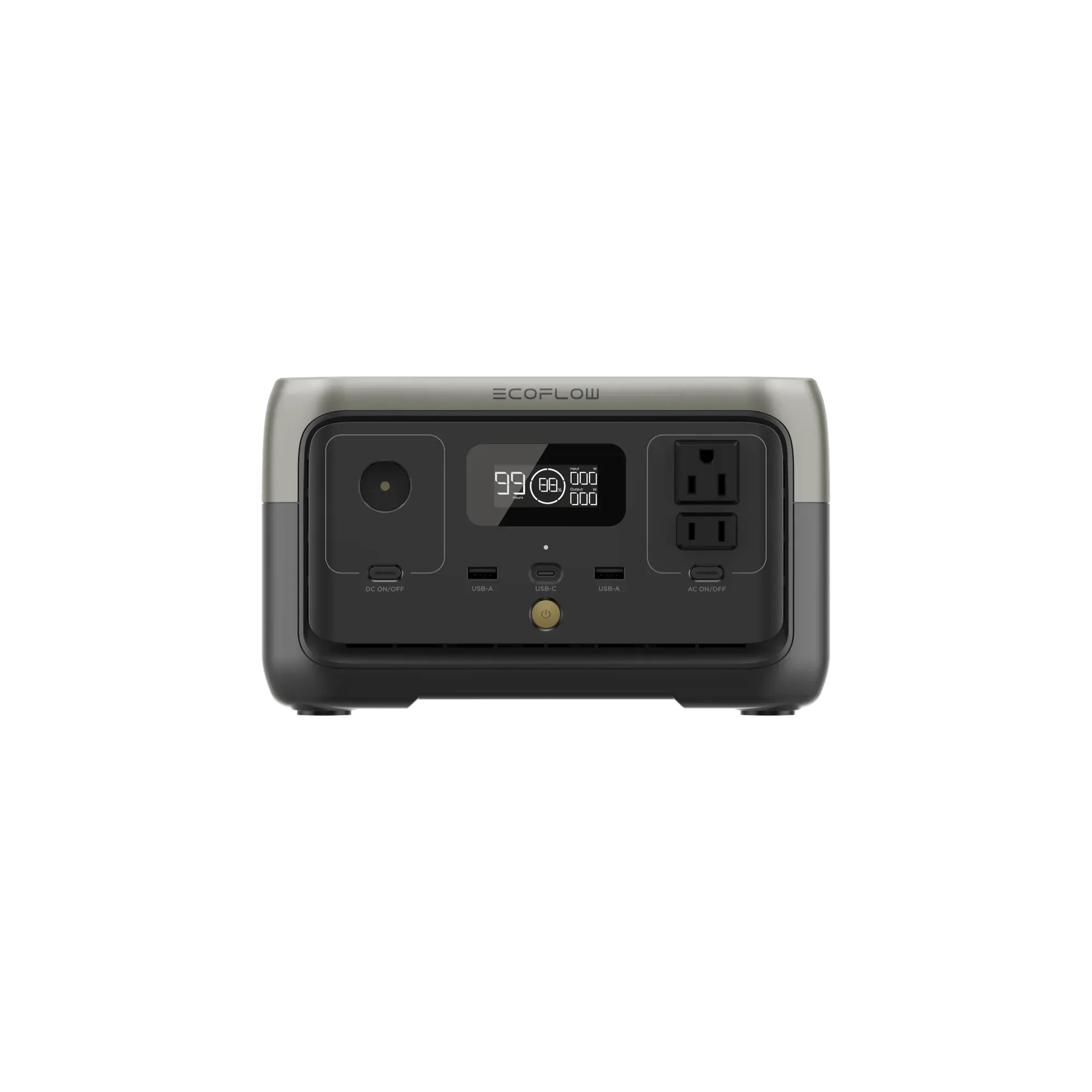
At 256 Wh and 300W continuous output, the RIVER 2 will not run a refrigerator, a space heater, or a sump pump. What it will do is keep your communication devices running for hours at a price point that makes it easy to justify as an insurance purchase.
The 600W X-Boost mode handles loads above 300W by reducing output voltage, giving it twice the peak capacity of the Anker C300 in this tier. EPS mode provides 30 ms switchover for automatic backup.
What it runs from our database: CPAP machines (with limited runtime), phones, laptops, LED lighting, routers, small fans.
CPAP runtime:
CPAP runtime on EcoFlow RIVER 2
256 Wh × 0.70 derate / 39W (Fisher & Paykel SleepStyle, typical settings) = 4.6 hours
4.6 hours is not a full night. If CPAP backup is a primary concern, the RIVER 2 is undersized. Check our CPAP compatibility page for runtime calculations across all power stations.
What it does not run: Anything with a compressor, heating element above 300W, or motor above 300W.
Key specs: 256 Wh, 300W / 600W X-Boost, LFP, 3,000 cycles to 80%, 110W solar input (XT60), EPS 30 ms switchover, 7.7 lbs. AC recharge: 60 minutes.
Why not the RIVER 3? The newer EcoFlow RIVER 3 costs $259 for 245 Wh — $20 more for 11 Wh less battery. Same running watts, same surge, same cycles. The RIVER 2 is the better value today.
Alternative: Anker SOLIX C300 ($249)
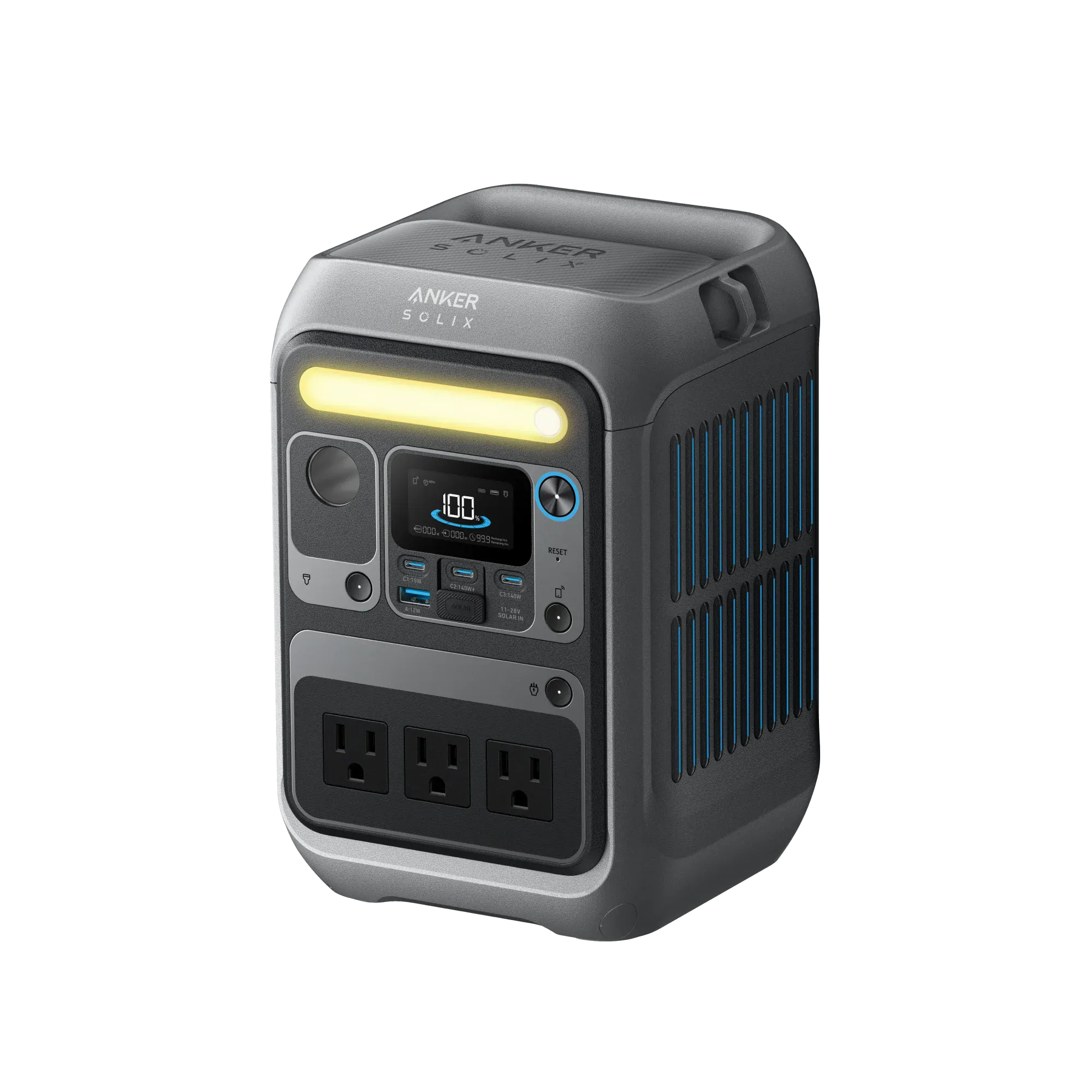
The C300 turns its weakness into a use case. Anker does not publish a surge rating, so we conservatively model it at 300W — half the RIVER 2’s peak. But its 10 ms UPS switchover is the fastest in this entire guide, and the dual 140W USB-C ports are the best laptop charging solution under $300.
Best for: Desk UPS for a laptop or workstation where instant switchover matters more than AC load flexibility.
Key specs: 288 Wh, 300W / 300W surge, LFP, 3,000 cycles to 80%, 100W solar input (XT60), UPS 10 ms switchover. AC recharge: 60 minutes.
Mid-Range Tier: The Weekender Class ($500-$700)
Best for: Camping with a mini-fridge, vanlife, short power outages where you need to keep a refrigerator cold. This is where portable power stations start handling compressor startup surges.
Winner: Bluetti AC70 ($599)
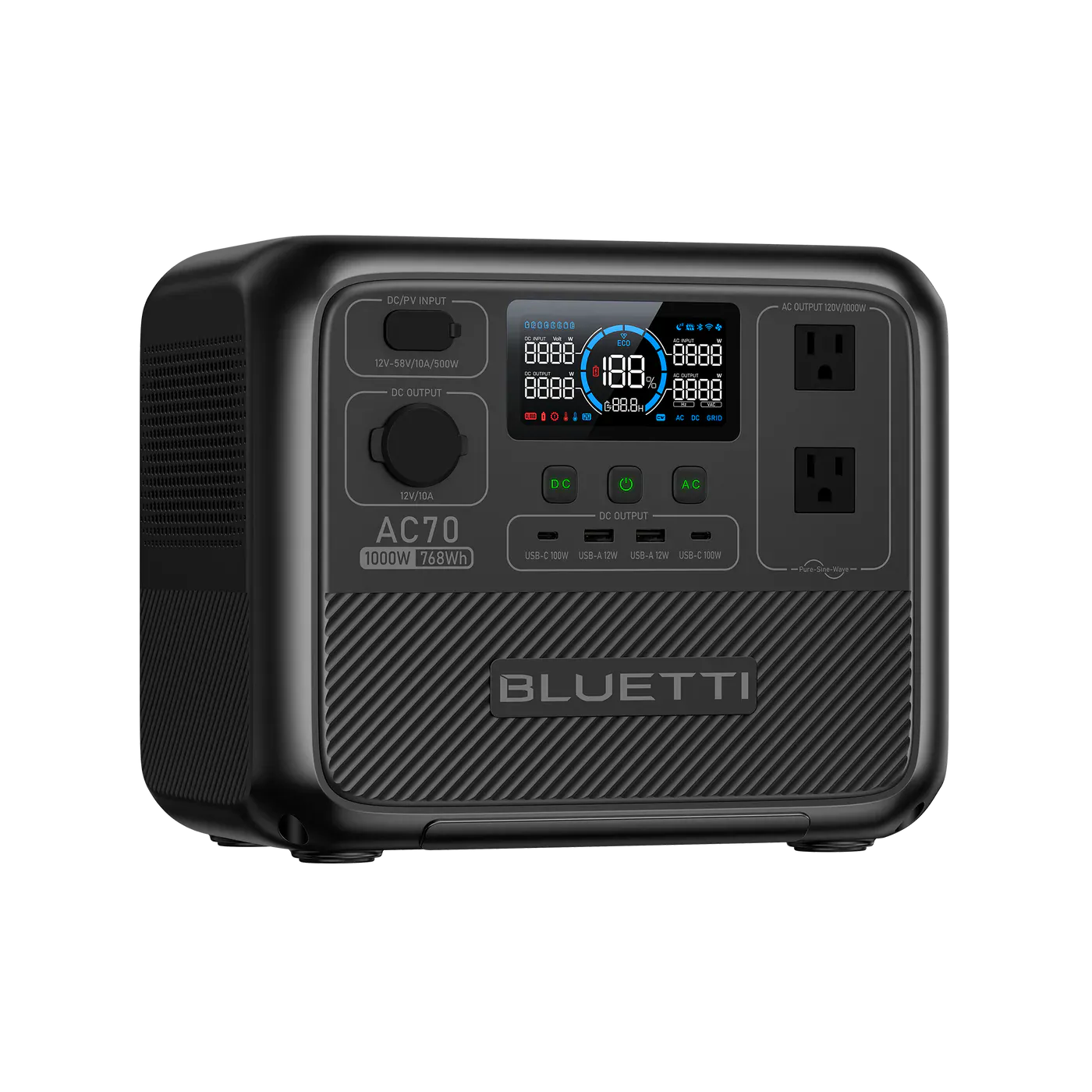
The AC70 is the surge leader of the mid-range. At 2,000W peak, it handles compressor startup events that the Anker C800 Plus (1,600W) and EcoFlow RIVER 2 Pro (1,600W) cannot. That is the difference between your camping fridge starting on battery power or the overload alarm going off.
Refrigerator compressors in our database surge between 1,200W and 2,100W at startup. The AC70’s 2,000W covers most of that range. The C800 Plus and RIVER 2 Pro at 1,600W are tight or fail on the higher end.
What it runs from our database: Most refrigerators (compressor surge permitting), CPAP machines, LED lighting, laptops, routers, fans, small kitchen appliances under 1,000W.
What it does not run: Space heaters (1,500W exceeds 1,000W running output), large air conditioners, sump pumps, high-draw power tools.
Key specs: 768 Wh, 1,000W / 2,000W surge, LFP, 3,000 cycles to 80%, 500W solar input (XT60), 100W USB-C. Price per Wh: $0.78.
Where it wins: Highest surge in the tier (2,000W). Lowest price at 768 Wh ($599). Best solar input (500W — nearly double the others). Standard XT60 connector for third-party panels.
Alternative: Anker SOLIX C800 Plus ($649)
If your loads are purely resistive (no compressors, no motors), the C800 Plus offers 1,200W continuous output — 200W more than the AC70. That extra headroom matters for running multiple electronic devices simultaneously or sustaining loads in the 1,000-1,200W range. But with 1,600W surge versus the AC70’s 2,000W, it fails on more compressor-start devices in our database. You pay $50 more for 400W less surge.
Best for: Sustained multi-device electronic loads where running watts matter more than surge.
Key specs: 768 Wh, 1,200W / 1,600W surge, LFP, 3,000 cycles to 80%, 300W solar input (XT60). Price per Wh: $0.85.
Premium Tier: The Home Hero Class ($800-$1,000)
Best for: Real home backup — refrigerator, CPAP, TV, microwave, lighting, communications. This tier handles compressor startups with margin and runs 1,800W continuous loads.
Winner: EcoFlow DELTA 3 Plus ($899)
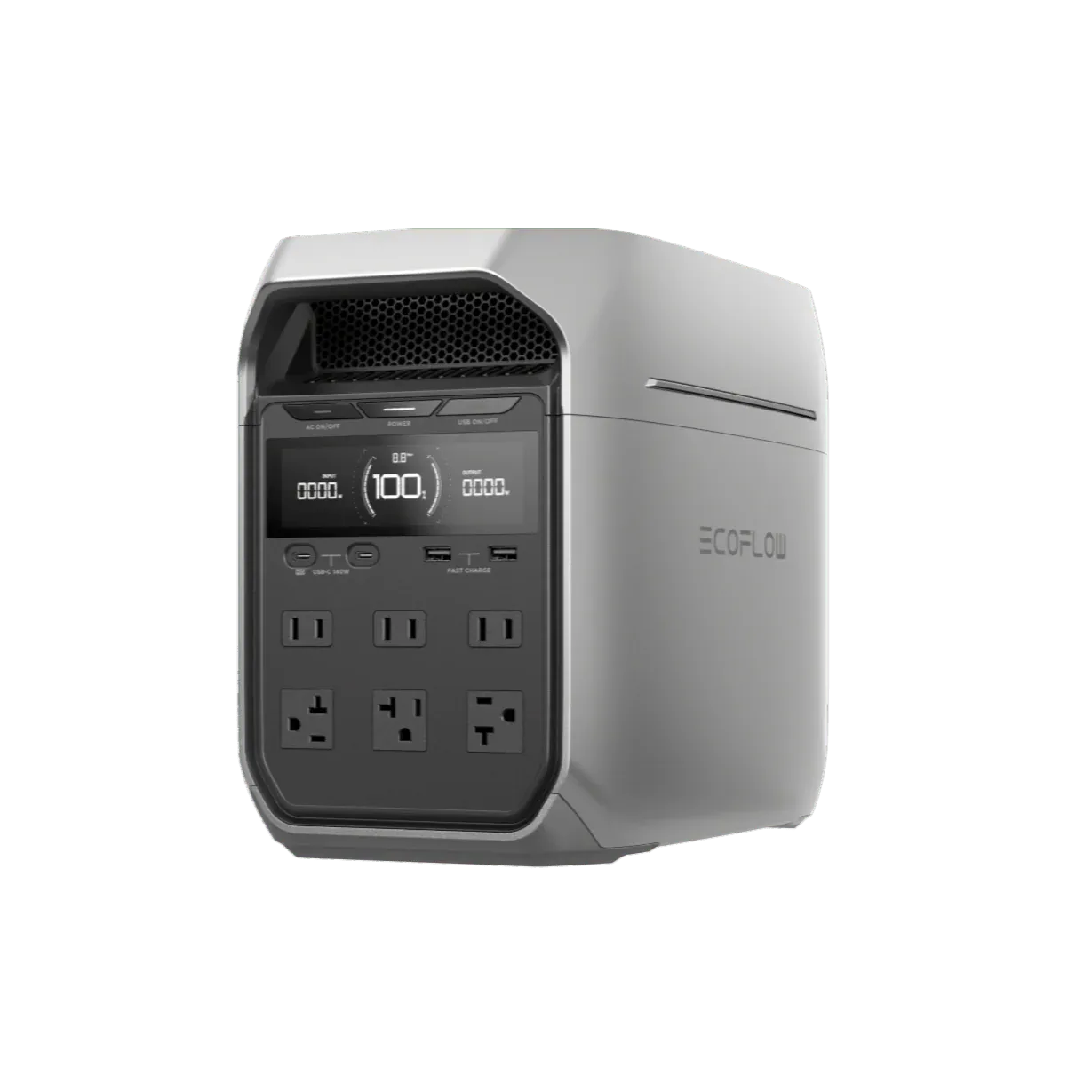
EcoFlow DELTA 3 Plus
The DELTA 3 Plus is the new standard for the 1 kWh class. At 3,600W surge, it has the highest peak capacity of any power station under $1,000 in our database. It starts devices that the Jackery 1000 v2 (3,000W), DELTA 2 (2,700W), and Anker C1000 (2,400W) cannot.
| DELTA 3 Plus | Jackery 1000 v2 | Anker C1000 | DELTA 2 | |
|---|---|---|---|---|
| Surge | 3,600W | 3,000W | 2,400W | 2,700W |
| Running | 1,800W | 1,500W | 1,800W | 1,800W |
| Cycles | 4,000 | 4,000 (70%) | 3,000 | 3,000 |
| Capacity | 1,024 Wh | 1,070 Wh | 1,056 Wh | 1,024 Wh |
| MSRP | $899 | $799 | $999 | $999 |
What it runs from our database: Refrigerators (all models), CPAP machines (all models), space heaters up to 1,500W (about 25 minutes of runtime at full draw), LED lighting, laptops, routers, fans, microwaves, and most kitchen appliances. For sump pumps: the Liberty Pumps 287 (2,645W surge) passes with 955W of margin. The Zoeller M98 (3,243W surge) passes with 357W of margin — something neither the Jackery 1000 v2 nor the C1000 can do.
What it does not run: Window and portable air conditioners with compressor surges above 3,600W, circular saws and other high-draw power tools above 1,800W continuous.
Key specs: 1,024 Wh, 1,800W / 3,600W surge, LFP, 4,000 cycles to 80%, expandable battery, 1,000W solar input (2× XT60i ports), 140W USB-C. AC recharge: 0 to 80% in 30 minutes. Price per Wh: $0.88.
Alternative: Jackery Explorer 1000 v2 ($799)
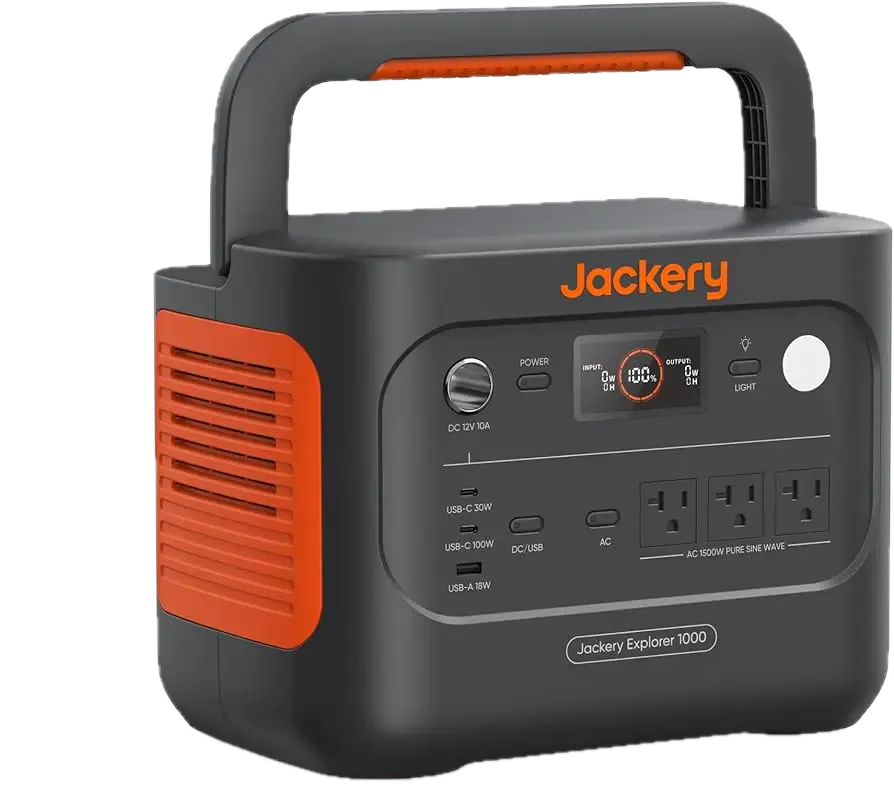
The Jackery costs $100 less than the DELTA 3 Plus. That is its primary advantage. At 3,000W surge and 1,500W running, it handles most of what the DELTA 3 Plus handles — but with 600W less surge headroom and 300W less continuous output.
For sump pumps, the Jackery passes the Liberty 287 (2,645W surge, 355W margin) but fails the Zoeller M98 (3,243W surge exceeds the 3,000W peak by 243W).
Key specs: 1,070 Wh, 1,500W / 3,000W surge, LFP, 4,000 cycles to 70%, UPS 20 ms switchover, 400W solar input (dual DC8020, Jackery panels only). Price per Wh: $0.75.
Solar input limitation: Jackery uses proprietary DC8020 connectors. You cannot connect third-party solar panels without an adapter. This locks you into Jackery’s panel ecosystem, which is typically priced higher per watt than alternatives. The DELTA 3 Plus accepts 1,000W of solar input via standard XT60i connectors.
Decision rule: If your priority is compressor startups — refrigerators, sump pumps, power tools — pick the DELTA 3 Plus for its 600W surge advantage. If price is the priority and your loads are lighter (no large compressors), the Jackery 1000 v2 at $100 less gets the job done.
Note on the Anker C1000 Gen 2: Anker released a second-generation C1000 in late 2025 with 2,000W continuous output, 3,000W surge, and 4,000 cycles (to 80 percent) at $799 MSRP. If this model enters our database with verified specs, it could change our premium tier recommendations. Check the Anker brand page for updates.
Quick Picks
| Need | Pick | Why |
|---|---|---|
| Emergency essentials | EcoFlow RIVER 2 ($239) | Lightest, fastest recharge, 600W X-Boost |
| Anything with a compressor | Bluetti AC70 ($599) | Best surge under $700 (2,000W) |
| Serious home backup | EcoFlow DELTA 3 Plus ($899) | Highest surge under $1K (3,600W), expandable |
If you know your loads, check the compatibility calculator to verify before buying. The detailed breakdowns follow below, along with models we recommend avoiding.
Models to Avoid
Not every power station under $1,000 is worth buying. Two models in our database are dominated by better alternatives at the same price.
EcoFlow DELTA (Gen 1) — $699
The original EcoFlow DELTA looks compelling on paper: 1,260 Wh capacity, 1,800W running, 3,300W surge, all for $699. The price per watt-hour ($0.55) is the best in this guide.
The problem is chemistry. The DELTA Gen 1 uses NMC (nickel manganese cobalt) batteries rated at just 800 cycles to 80 percent. Every other power station in this guide uses LFP with 3,000 to 4,000 cycles. At 800 cycles, the DELTA Gen 1 will degrade to 80 percent capacity in a fraction of the time. It is also a legacy product no longer in active production, which means limited firmware updates and accessory support going forward.
For $100 less, the Bluetti AC70 ($599) gives you LFP chemistry with 3,000 cycles. For $100 more, the Jackery 1000 v2 ($799) gives you LFP with 4,000 cycles and comparable surge capacity. The DELTA Gen 1 sits in a dead zone.
EcoFlow RIVER 2 Pro — $599
At $599 with 768 Wh, the RIVER 2 Pro has the same battery capacity as the Bluetti AC70. But it delivers 800W running and 1,600W surge versus the AC70’s 1,000W running and 2,000W surge. For the same price, you get 200W less running power and 400W less surge. There is no scenario in our database where the RIVER 2 Pro outperforms the AC70 on compatibility.
The Verdict
On a budget: EcoFlow RIVER 2 at $239. The right tool for the right job. It keeps phones charged, lights on, and a CPAP running during short outages. At 7.7 lbs and 60-minute recharge, it is the power station you actually grab when the lights go out.
For camping and short backup: Bluetti AC70 at $599. The surge leader of the mid-range at 2,000W peak. It starts camping fridges and small compressor loads that the competition in this price range cannot. The best surge per dollar under $700.
For home backup: EcoFlow DELTA 3 Plus at $899. The new king of the 1 kWh class. Highest surge (3,600W), fastest charge (0-80% in 30 minutes), most cycles (4,000 to 80%), expandable battery, and $100 less than the Anker C1000. If you are buying one power station under $1,000 for serious emergency preparedness, this is the pick.
Recommended Reading
Use our compatibility calculator to check any power station against your specific devices before buying.
The How to Size a Portable Power Station guide covers the general sizing framework, including the 0.70 derate factor and buffer calculations used throughout this article.
If surge capacity is the deciding factor for your purchase, the Surge Watts Explained guide covers the physics of motor startup surge and why it matters more than running watts.
All picks in this guide use LFP batteries. The LFP vs NMC Battery Chemistry guide explains why that matters for longevity, safety, and cost per cycle — and why we flag the one NMC unit as a model to avoid.
Sources: Specifications verified from EcoFlow RIVER 2 User Manual, Anker SOLIX C300 User Manual, Bluetti AC70 User Manual, EcoFlow DELTA 3 Plus User Manual, Jackery Explorer 1000 v2 User Manual, and Anker SOLIX C1000 User Manual. UPS switchover times from Jackery blog, Anker product page, and EcoFlow FAQ. Device wattage from OEM manuals and spec sheets per our data methodology.