
Choosing a power station for camping or RV use is a fundamentally different exercise from choosing one for home backup. The priorities shift. Weight matters because you are carrying the station from your vehicle to a campsite, lifting it in and out of a truck bed, or fitting it into an already packed RV. Solar recharging matters because you may be off-grid for days without access to a wall outlet. And the loads are lighter: you are powering a CPAP machine, charging phones and laptops, running LED lighting, and maybe keeping a 12V mini fridge cold.
A typical camping setup draws 200 to 400 Wh per day. That includes a CPAP machine running overnight (roughly 56W for 8 hours = 448 Wh before accounting for duty cycle), phone and laptop charging (50 to 100 Wh), LED lights (10 to 30 Wh), and a portable fan (20 to 50 Wh). An RV with a 12V compressor fridge adds another 80 to 200 Wh per day depending on the ambient temperature and how often the door opens.
The implication: you do not need 4,000 Wh of capacity or 4,000W of output for camping. You need the right balance of capacity, portability, solar compatibility, and port selection. Here are the best options from our database, organized by use case.
Comparison Table
| Model | Capacity | Running W | Surge W | Weight | Max Solar | USB-C | Cycles |
|---|---|---|---|---|---|---|---|
| Anker SOLIX C300 | 288 Wh | 300W | 600W (SurgePad) | 9.0 lbs | 100W (XT60) | 140W | 3,000 |
| EcoFlow RIVER 2 | 256 Wh | 300W | 600W (X-Boost) | 7.7 lbs | 110W (XT60) | 60W | 3,000 |
| Jackery Explorer 300 Plus | 288 Wh | 300W | 600W | 8.3 lbs | 100W (USB-C) | 100W | 3,000 |
| Jackery Explorer 1000 v2 | 1,070 Wh | 1,500W | 3,000W | 23.8 lbs | 400W (DC8020) | 100W | 4,000 |
| Anker SOLIX C1000 | 1,056 Wh | 1,800W | 2,400W (SurgePad) | 28.6 lbs | 600W (XT60) | 100W | 3,000 |
All five models use LFP (LiFePO4) battery chemistry, which means longer cycle life and better thermal stability than older NMC lithium-ion cells. All include pure sine wave AC inverters safe for sensitive electronics. For a deep dive into battery chemistry differences, see our LFP vs NMC guide.
Best Ultralight: Anker SOLIX C300
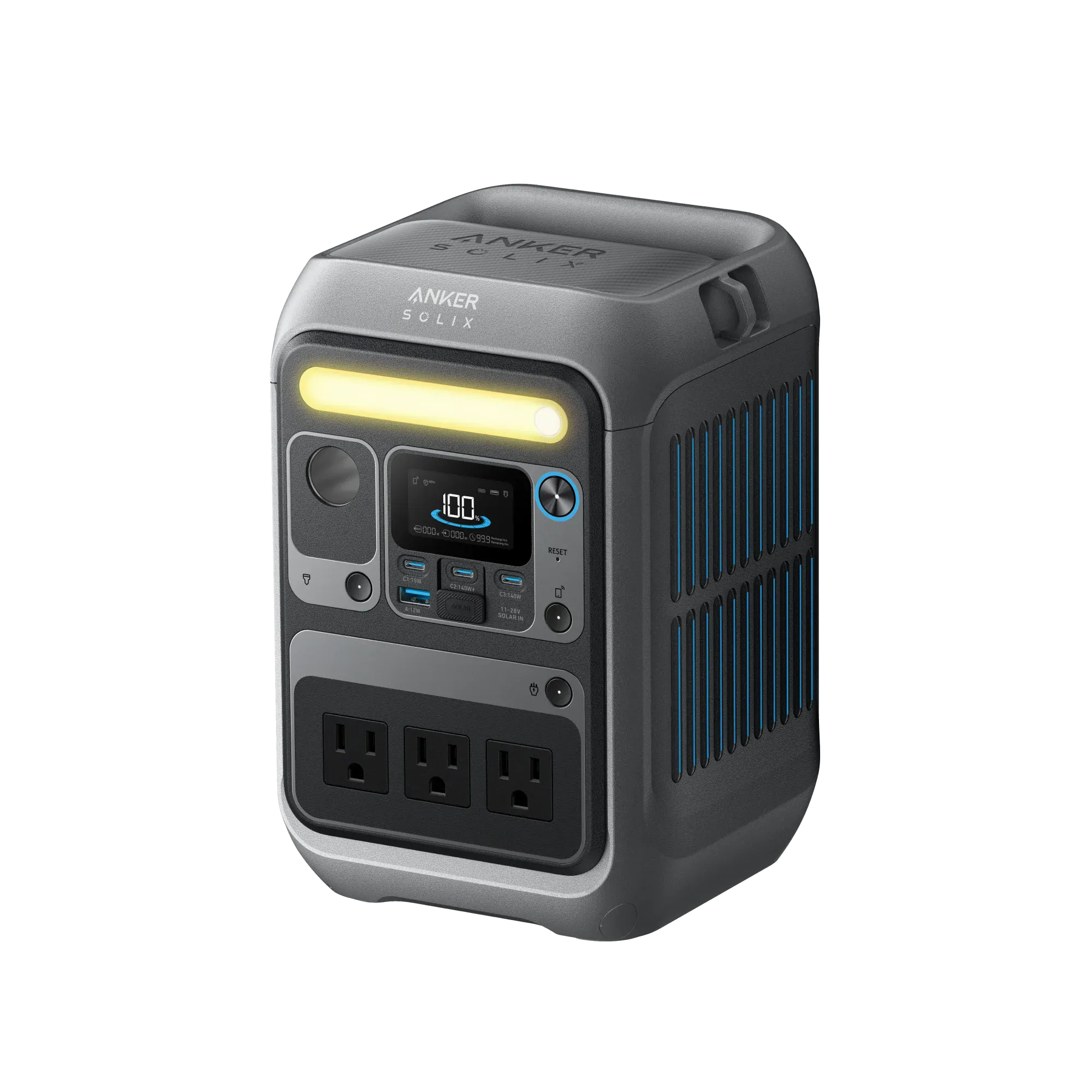
The C300 is designed for portability. At 9 pounds it fits into a daypack, and the optional carrying strap turns it into a shoulder bag. Anker bills it as 15% smaller than comparable 300 Wh stations.
The standout feature for campers is the dual 140W USB-C ports. These can charge a MacBook Pro at full speed while simultaneously charging a phone. The C300 also supports two-way USB-C charging: you can recharge the station itself through those same ports using any USB-C PD charger rated at 140W, reaching 80% in about 50 minutes. This means you can top off the station at a coffee shop or visitor center without carrying a separate AC cable.
Solar input is capped at 100W via an XT60 connector, accepting panels in the 11 to 28V MPPT range. A single 100W portable panel recharges the 288 Wh battery in approximately 4.1 hours of good sunlight (using our standard 0.70 real-world derate factor: 288 / (100 × 0.70) = 4.1 hours). That is achievable in a single clear day across most of the continental US.
The C300 also functions as a mini UPS with a switchover time under 10 milliseconds, which matters if you use it at home between trips to keep a router or NAS running during brief outages. See our UPS mode guide for details.
Best for: solo campers, backpackers with vehicle access, CPAP users on weekend trips, digital nomads who need fast USB-C charging.
Limitation: 300W continuous output means it cannot power high-wattage appliances like a coffee maker or hair dryer. SurgePad extends this to 600W but with reduced voltage. It is a device-charging and light-load station, not a full kitchen solution.
Best Budget: EcoFlow RIVER 2
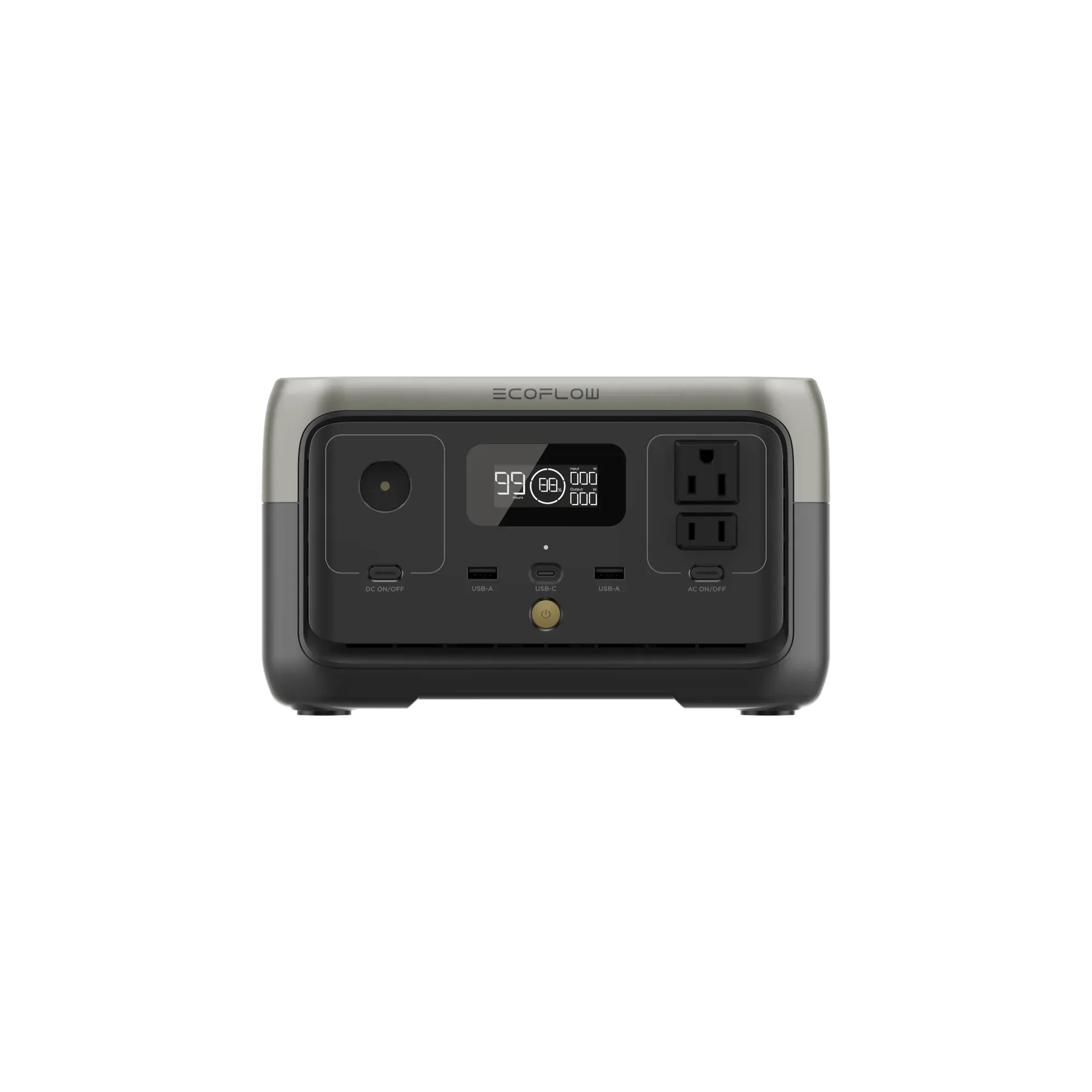
At 7.7 pounds, the RIVER 2 is the lightest station in this roundup and one of the lightest LFP power stations on the market. It charges from 0 to 100% in 60 minutes from a wall outlet using EcoFlow’s X-Stream technology, making it easy to grab-and-go.
EcoFlow’s X-Boost mode is functionally similar to Anker’s SurgePad: it allows the 300W inverter to handle loads up to 600W by reducing the output voltage slightly. This works for resistive loads like small heaters or incandescent lights, but it is not suitable for sensitive electronics or devices with voltage protection.
Solar input accepts up to 110W via XT60, with an MPPT range of 11 to 30V. Under realistic field conditions with our 0.70 derate, expect approximately 3.3 hours for a full charge with a 110W panel (256 / (110 × 0.70) = 3.3 hours).
The RIVER 2 includes AC outlets, USB-A, USB-C, and a DC car socket. The USB-C port maxes out at 60W, which is enough for most laptops but will not fast-charge a MacBook Pro 16-inch at full speed. The station connects to the EcoFlow app via WiFi and Bluetooth for remote monitoring.
Best for: budget-conscious campers, ultralight setups, car camping weekends, anyone who values fast wall charging for last-minute trips.
Limitation: 256 Wh is the smallest capacity in this roundup. For multi-day trips without solar, it may run out quickly. USB-C output at 60W is adequate but lags behind the 100W to 140W ports on every other station in this list.
Also Consider: Jackery Explorer 300 Plus
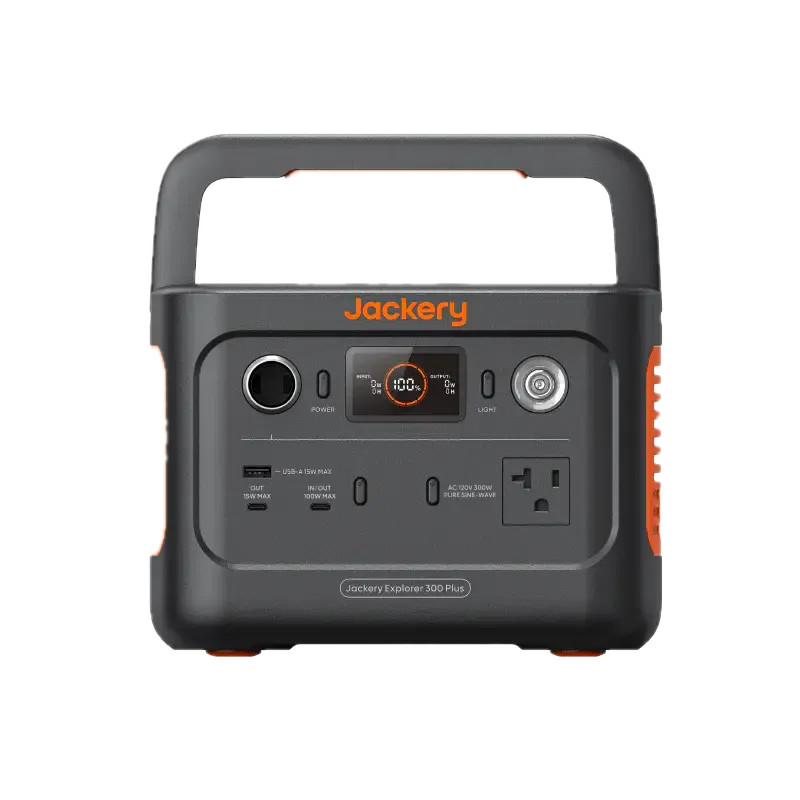
The 300 Plus splits the difference between the C300 and RIVER 2. It matches the C300’s 288 Wh capacity and 600W surge, with 100W USB-C output, at a weight of 8.3 pounds.
A single 100W panel recharges the 288 Wh battery in approximately 4.1 hours of good sunlight (288 / (100 × 0.70) = 4.1 hours). The USB-C solar input is both its unique feature and its main limitation: convenient because any USB-C PD source can charge it, restrictive because it caps solar input at 100W and 5A.
Best for: campers who want the simplicity of USB-C for everything (charging in, charging out) and do not need the C300’s 140W USB-C speed or the RIVER 2’s ultra-low weight.
Best Mid-Range: Jackery Explorer 1000 v2
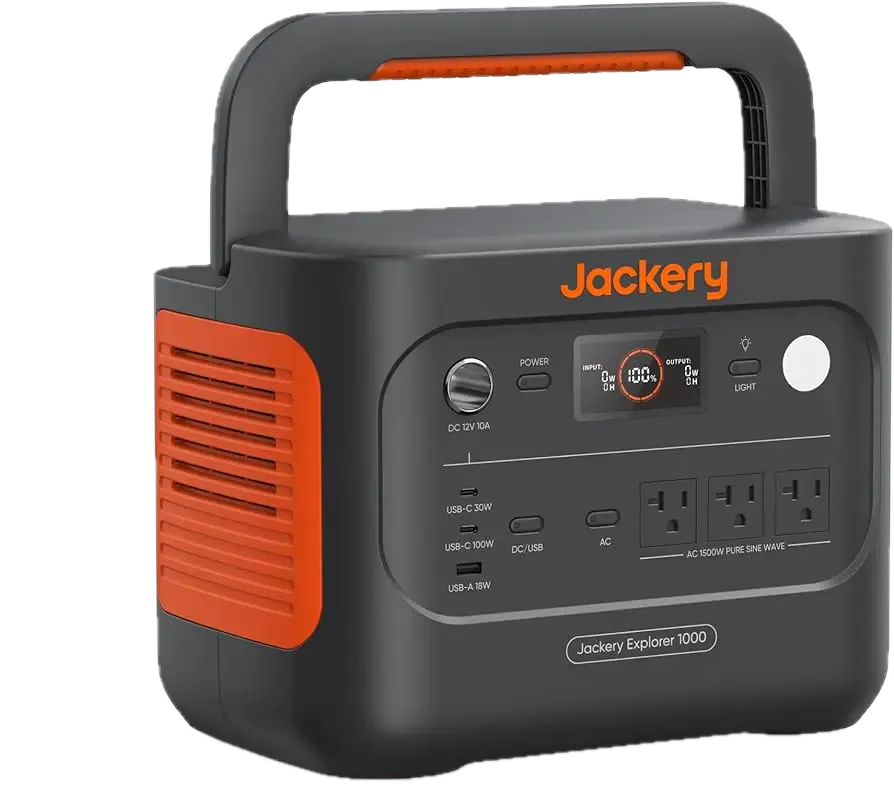
The Jackery Explorer 1000 v2 sits at the transition point between “portable camping gadget” and “serious power source.” At 23.8 pounds, it is not something you carry on a hike, but it fits easily in an RV cabinet or truck bed, and the foldable handle makes short carries manageable.
The 3,000W surge rating is the headline number for RV users. That is enough to start a 12V compressor fridge (typical surge 600 to 1,200W), a small window AC unit, or a blender. The 1,500W continuous output handles sustained loads like a portable induction cooktop, electric kettle, or hair dryer. These are appliances that the 300W ultralight stations simply cannot run.
Solar input accepts up to 400W total across two DC8020 ports (200W max per port). With two 200W panels (one per port), you can recharge 1,070 Wh in approximately 3.8 hours of good sun (1,070 / (400 × 0.70) = 3.8 hours). A single 200W panel takes approximately 7.6 hours (1,070 / (200 × 0.70) = 7.6 hours). For multi-day camping, the two-panel setup is strongly recommended.
Station: 1,070 Wh. Device: CPAP at 56W. Derate: 0.70.
1,070 × 0.70 / 56 = 13.4 hours
Roughly 1.5 to 2 nights of sleep therapy depending on pressure settings and mask leak. Add a 200W solar panel to extend indefinitely.
Wall charging uses Jackery’s ChargeShield 2.0 technology. Standard mode charges 0 to 100% in 1.7 hours. Emergency mode (activated via the Jackery app) pushes that down to 1 hour but generates more heat and is intended for occasional use, not daily cycling. For more on fast charging trade-offs, see our charging speed guide.
The Explorer 1000 v2 includes UPS functionality with a switchover time under 20 milliseconds, three AC outlets, dual USB-C (100W and 30W), USB-A, and a DC car port. The 4,000-cycle LFP battery is rated for 10+ years of regular use.
Best for: RV owners, extended camping trips, couples or families who need to power real appliances, CPAP users who want multi-night capacity without solar.
Limitation: at 23.8 pounds, it is not backpack-friendly. No expandable battery option (unlike the Jackery Explorer 2000 Plus or the Anker C1000).
Best Solar Ecosystem: Anker SOLIX C1000
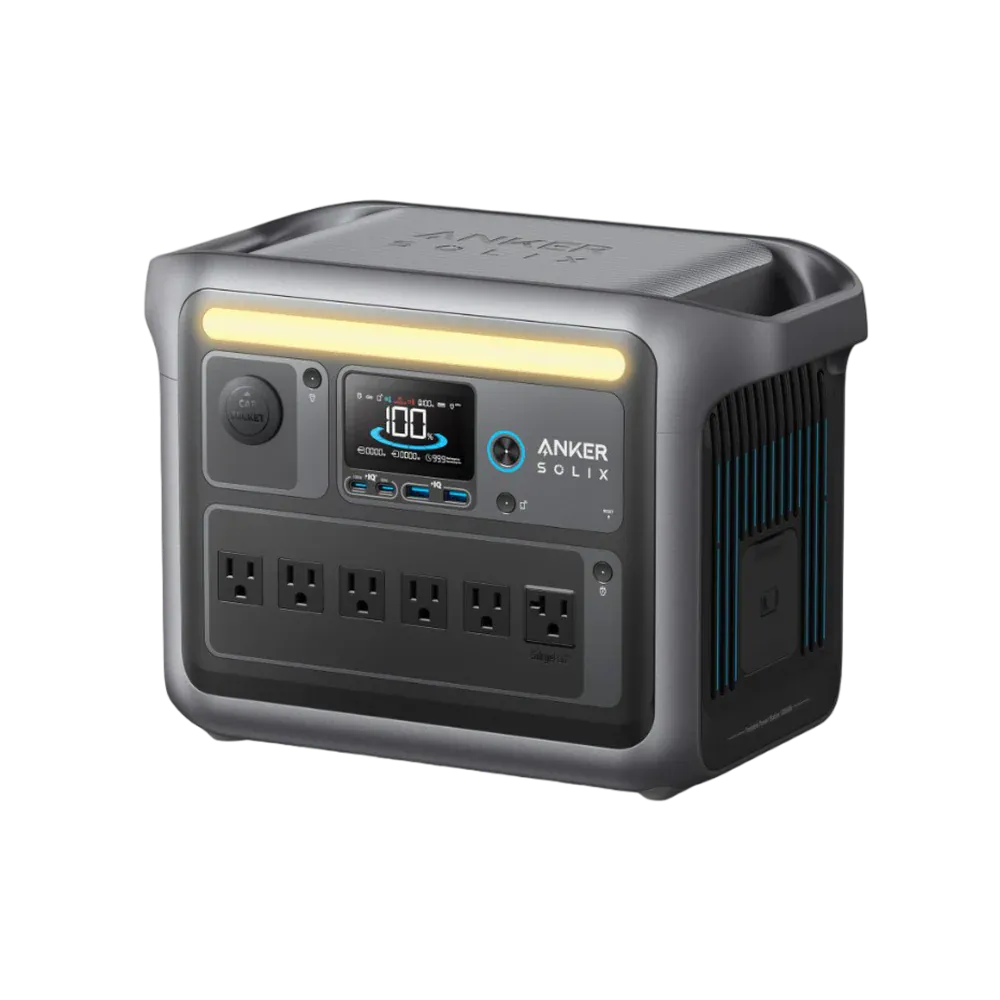
The Anker SOLIX C1000 accepts up to 600W of solar input through its XT60 port (11 to 60V MPPT range), the highest solar capacity in this roundup. With a 600W panel array, it recharges in approximately 2.5 hours under realistic conditions (1,056 / (600 × 0.70) = 2.5 hours). For campers who plan to rely primarily on solar, this is the strongest option.
The 1,800W continuous output and 2,400W SurgePad surge give the C1000 enough muscle for most RV appliances. It runs refrigerators, blenders, coffee makers, and power tools without issue. The 11 output ports include five AC outlets, USB-C (up to 100W), USB-A, and a 12V car socket.
Wall charging is where the C1000 stands out from every other station in its class: 0 to 100% in 58 minutes using HyperFlash mode (1,300W AC input, activated through the Anker app, requires battery temperature above 68 degrees F). For campers who decide to go on a last-minute trip, the C1000 can be fully charged during the time it takes to pack the car.
The C1000 is also expandable. Pairing it with an Anker SOLIX B1000 expansion battery doubles the capacity to 2,112 Wh, turning a weekend station into a multi-day power system without requiring a second inverter or controller.
At 28.6 pounds, the C1000 is the heaviest station in this roundup. It is a two-hand lift for most people and is better suited to staying in the RV or at a base camp than being carried to remote sites.
Best for: solar-first campers, RV owners who want expansion flexibility, extended off-grid trips, users who need fast wall charging for spontaneous departures.
Limitation: heaviest option at 28.6 lbs. The XT60 solar connector means you need XT60-compatible panels or MC4-to-XT60 adapters. SurgePad reduces voltage, so it is not appropriate for voltage-sensitive equipment.
Solar Recharging for Extended Trips
Solar recharging transforms a power station from a finite battery into a renewable energy system. On a multi-day camping trip, even a modest solar panel can extend your station’s effective capacity indefinitely, provided your daily consumption stays below your daily solar harvest.
Daily Wh = Panel rated watts × 0.70 × peak sun hours
Peak sun hours: typically 4 to 6 in summer, 2 to 4 in winter across the continental US.
100W panel in summer: 100 × 0.70 × 5 hours = 350 Wh per day. Enough to fully recharge an Anker C300 (288 Wh) or EcoFlow RIVER 2 (256 Wh) with energy to spare.
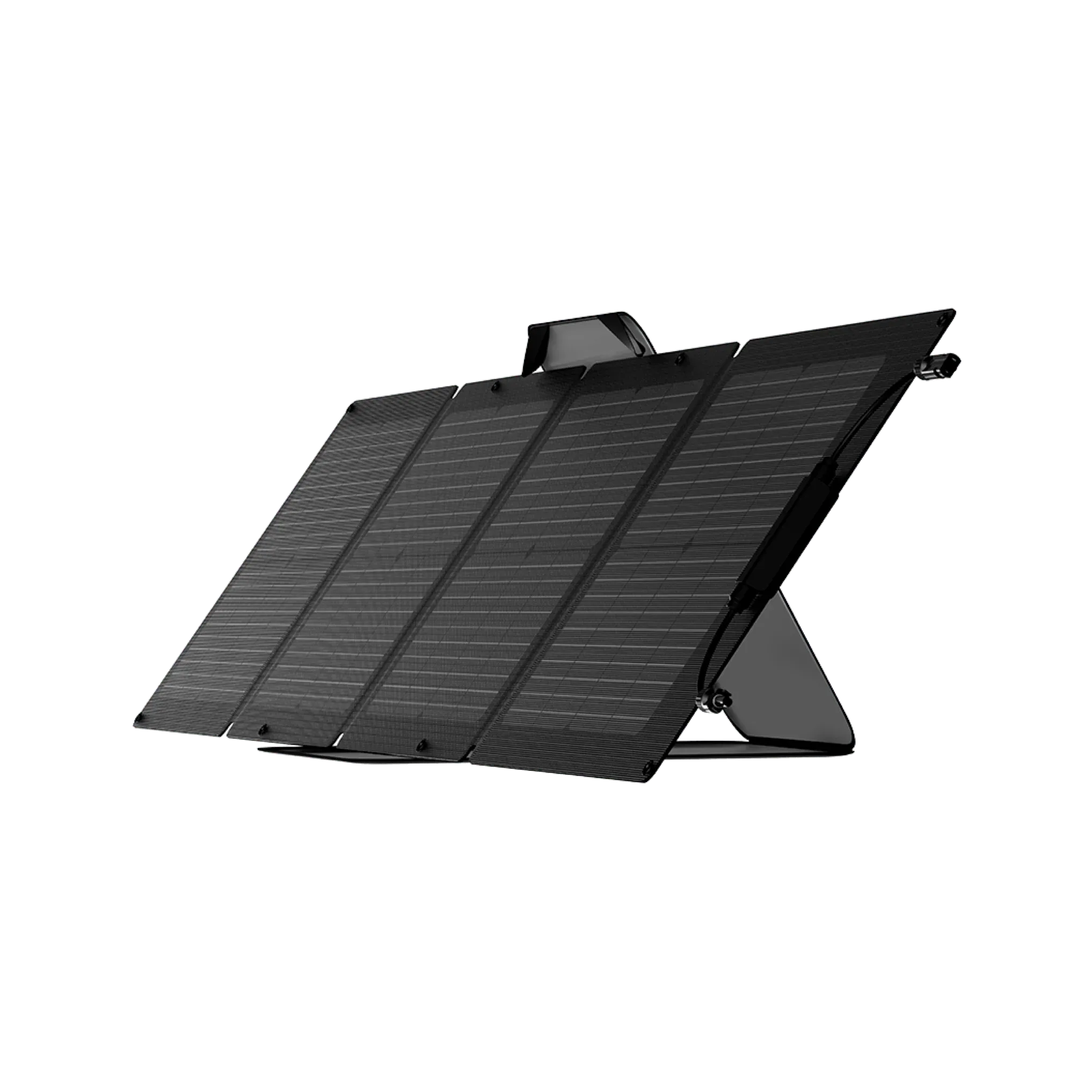
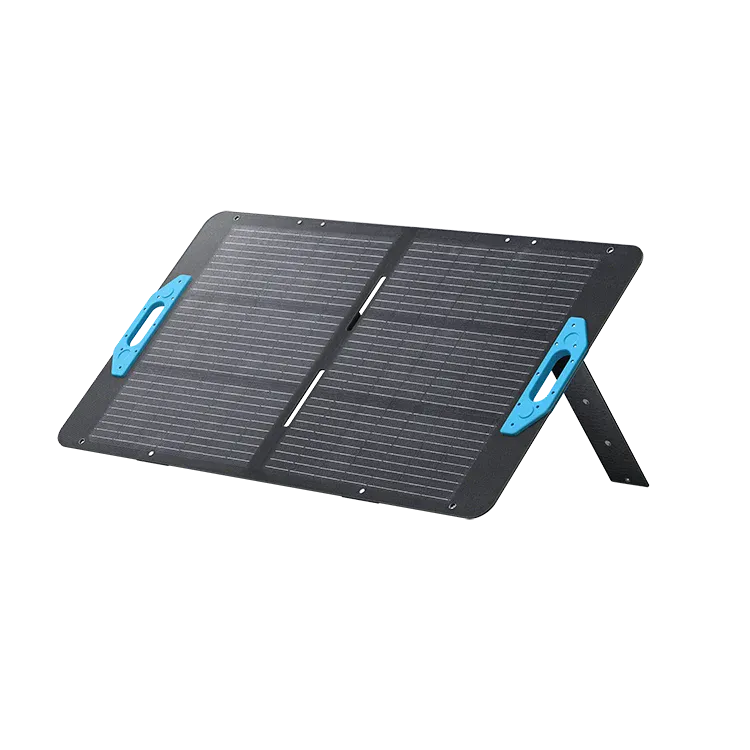
Anker SOLIX PS100 Portable Solar Panel (100W)
200W panel in summer: 200 × 0.70 × 5 hours = 700 Wh per day. Enough to cover most RV daily loads (400 to 600 Wh) and partially recharge a 1,000 Wh station.
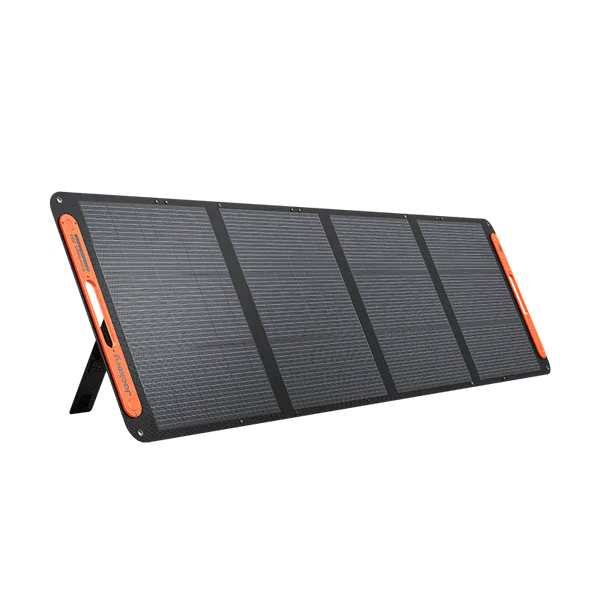
Jackery SolarSaga 200W Solar Panel
Two 200W panels in summer: 400 × 0.70 × 5 hours = 1,400 Wh per day. Enough to fully recharge a Jackery 1000 v2 or Anker C1000 while still powering daytime loads.
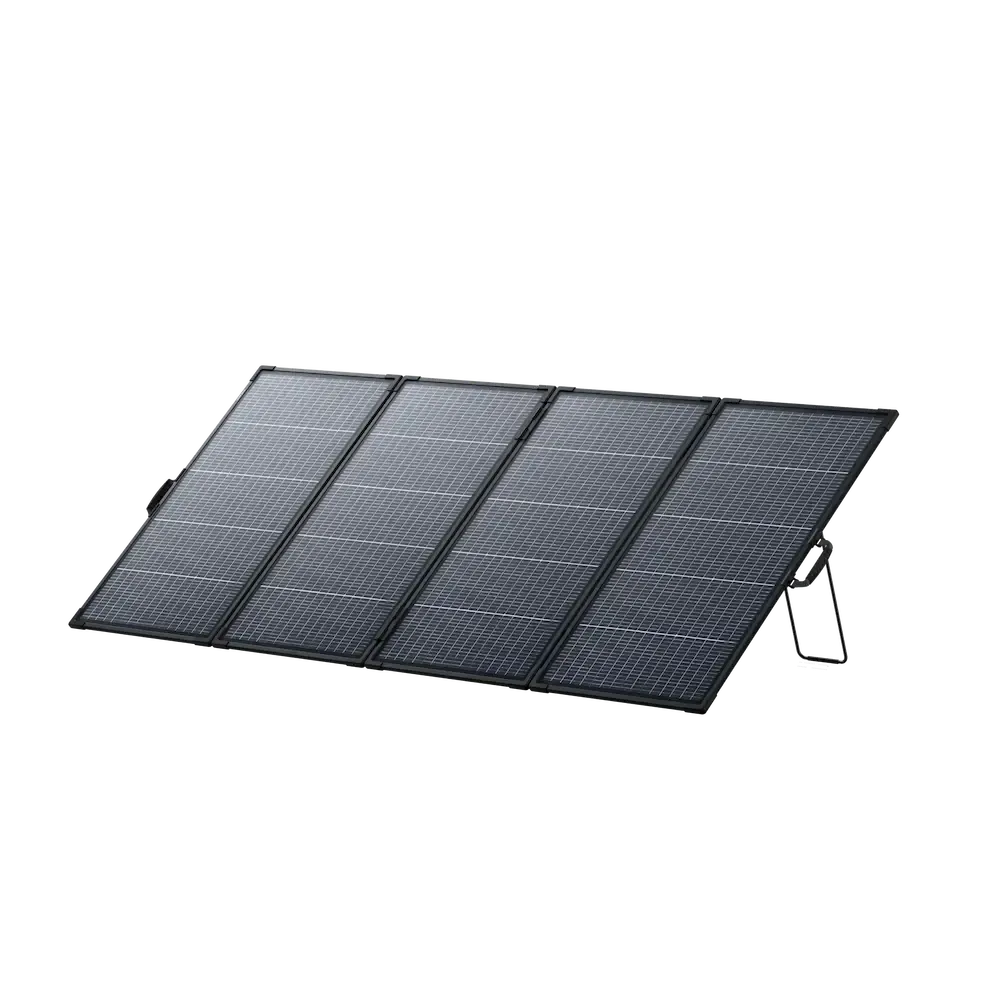
Anker SOLIX PS400 Portable Solar Panel (400W)
Connector compatibility matters. The three most common solar input connectors on portable power stations are XT60 (used by Anker and EcoFlow), DC8020/DC8mm (used by most Jackery models), and MC4 (the universal standard on standalone solar panels). If your panels use MC4 connectors and your station uses XT60, you need an MC4-to-XT60 adapter cable. The Jackery Explorer 300 Plus is the exception in this roundup: it uses USB-C for solar input, not a barrel connector.
For detailed charge time estimates for your specific station and panel combination, use our solar charge time calculator. For guidance on wiring multiple panels in series or parallel, see our series vs. parallel solar panel guide.
How to Choose
The right station depends on your camping style:
Weekend car camper, light loads (phones, laptops, lights, fan): Anker C300 or EcoFlow RIVER 2. Both are under 10 pounds, charge quickly from a wall outlet, and recharge in one day from a single 100W panel. The C300 wins on USB-C speed (140W vs 60W). The RIVER 2 wins on weight (7.7 vs 9.0 lbs) and price.
CPAP user on multi-night trips: Jackery Explorer 1000 v2. The 1,070 Wh capacity runs a typical CPAP for roughly 1.5 to 2 nights without recharging. Add a 200W solar panel to extend indefinitely. See our CPAP battery backup guide for device-specific details.
RV owner who wants to run real appliances: Anker C1000 or Jackery 1000 v2. Both deliver 1,000+ Wh and enough output wattage for kitchen appliances, entertainment systems, and climate control. The C1000 offers faster wall charging (58 min vs 1.7 hours) and higher solar input (600W vs 400W). The 1000 v2 is 5 pounds lighter with a higher surge rating (3,000W vs 2,400W).
Extended off-grid, solar-dependent: Anker C1000 with B1000 expansion battery (2,112 Wh total) and a 400 to 600W panel array. The high solar input ceiling means you can harvest more energy per day than any other station in this roundup.
For any of these stations, check specific device compatibility using our compatibility calculator before your trip. For budget-focused options that also work for camping, see our best power station under $1,000 guide.