
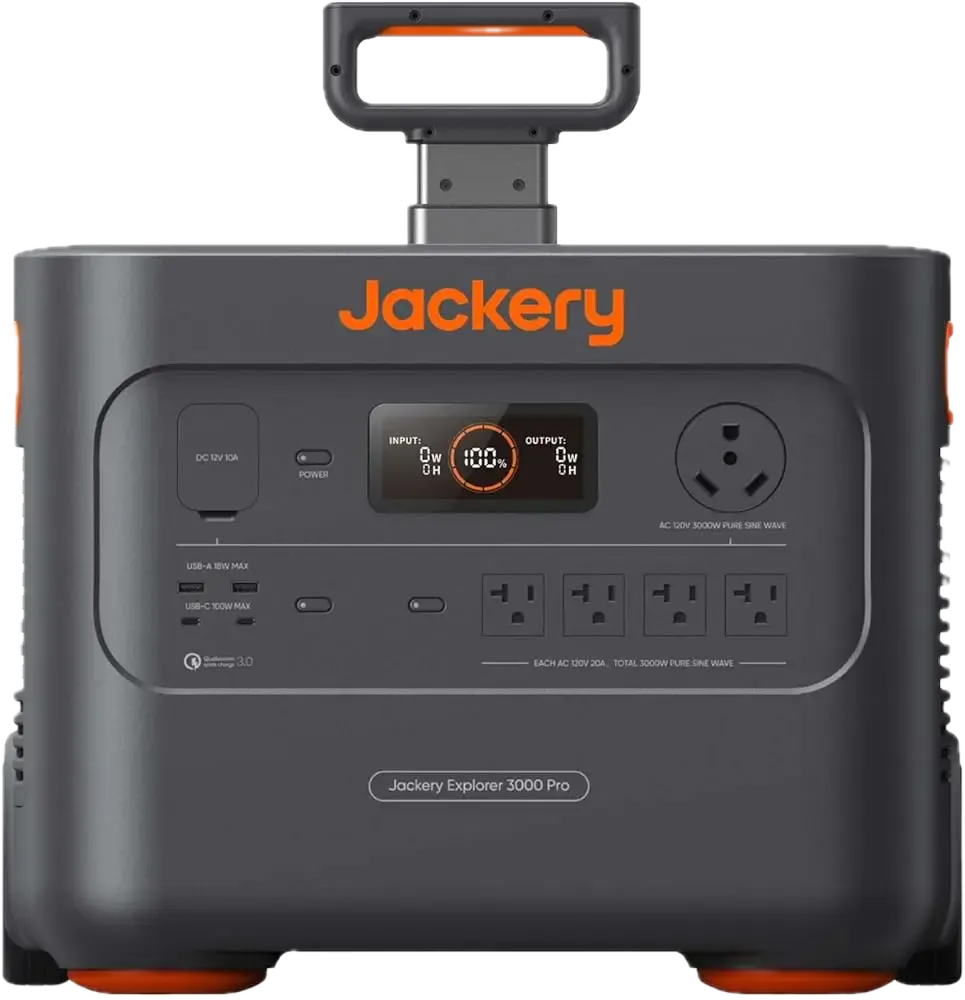
Capacity
Higher is better | Scale max: 3,994 Wh | Yeti Pro 4000 leads
Yeti Pro 4000 3,993.6 Wh
Explorer 3000 Pro 3,024 Wh
Yeti Pro 4000: +970 Wh (+32.1%).
This comparison targets buyers choosing between two high-capacity portable power stations for home backup, off-grid setups, or heavy appliance use. The Yeti Pro 4000 delivers 3600W of running power and 3993.6 Wh of capacity, giving it a clear edge over the Explorer 3000 Pro's 3000W and 3024 Wh.
Goal Zero's unit also supports expandable battery storage and accepts up to 3000W of solar input, more than double the Jackery's 1400W max. LFP chemistry and a 4000-cycle rating give the Yeti Pro a longer service life compared to the Explorer 3000 Pro's NMC cells rated at 2000 cycles.
Both stations powered the same 47 out of 53 devices tested, so real-world device coverage is effectively identical. The tradeoff is weight: the Yeti Pro tips the scale at 115.7 lbs, nearly twice the Explorer 3000 Pro's 63.9 lbs, which matters if portability is part of your plan.
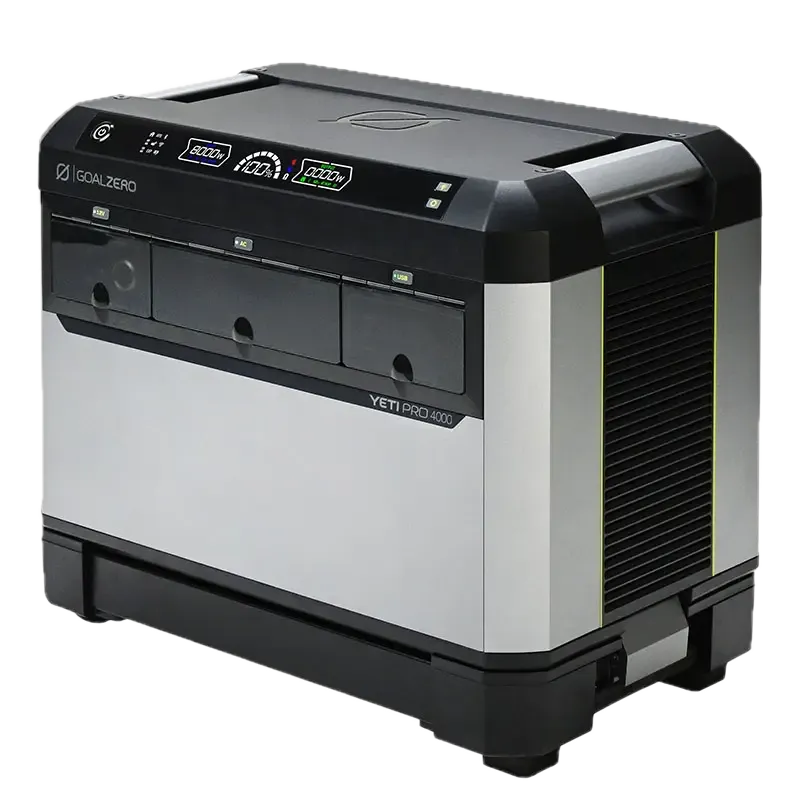
Overall Winner
Yeti Pro 4000
Powers 47 of 53 tested devices
Yeti Pro 4000 wins overall, but the best pick depends on your use case.
Absolute values shown. Bars are scaled within this comparison for readability.
Each metric is independent. Bar lengths are not comparable across different compare pages.
Yeti Pro 4000: +970 Wh (+32.1%).
Yeti Pro 4000: +600 W (+20.0%).
Yeti Pro 4000: +1,200 W (+20.0%).
Explorer 3000 Pro: -51.8 lbs (44.8% lighter).
Yeti Pro 4000: +2,000 cycles (+100.0%).
These two stations produce the same result on 53 of 53 devices.
Both can run: 47 · Neither can run: 6
These are 240V or high-voltage devices — neither station supports them.
Central AC (3-Ton)
Electric Water Heater (50 Gal)
Well Pump (1 HP)
Electric Clothes Dryer
RV Rooftop AC (13,500 BTU)
Pancake Air Compressor (6-Gallon)
| Spec | Yeti Pro 4000 | Explorer 3000 Pro |
|---|---|---|
| Capacity | 3,993.6 Wh ✓ | 3,024 Wh |
| Running Power | 3,600 W ✓ | 3,000 W |
| Surge Power | 7,200 W ✓ | 6,000 W |
| Weight | 115.7 lbs (52.5 kg) | 63.9 lbs (29.0 kg) ✓ |
| Energy Density | 76.1 Wh/kg | 104.3 Wh/kg ✓ |
| Portability Tier | stationary | heavy |
| Chemistry | LFP | NMC |
| Cycle Life | 4,000 ✓ | 2,000 |
| Expandable | Yes | No |
| UPS | No | No |
| AC Voltage | 120V | 120V |
Best-case charging profile using compatible solar panels.
MPPT: 13.3-145V
MPPT: 17.5-60V
Charge speed comparison
Longer bar = faster charge (inverted scale)
All tested devices grouped by category. Click a category to expand.
| Device | Yeti Pro 4000 | Runtime | Explorer 3000 Pro | Runtime |
|---|---|---|---|---|
| Box Fan (20-inch) | Safe | 33.7h | Safe | 25.5h |
| Central AC (3-Ton) | Voltage Fail | N/A | Voltage Fail | N/A |
| Dehumidifier (70 Pint) | Safe | 3.3h | Safe | 2.5h |
| Gas Furnace Fan (Blower) | Safe | 2.6h | Safe | 2h |
| Portable AC (12,000 BTU) | Safe | 2.1h | Safe | 1.6h |
| Space Heater (1,500W) | Safe | 1.9h | Safe | 1.4h |
| Window AC (8,000 BTU) | Safe | 3.9h | Safe | 3h |
| Device | Yeti Pro 4000 | Runtime | Explorer 3000 Pro | Runtime |
|---|---|---|---|---|
| Electric Water Heater (50 Gal) | Voltage Fail | N/A | Voltage Fail | N/A |
| Garage Door Opener (Residential) | Safe | 15.5h | Safe | 11.8h |
| Well Pump (1 HP) | Voltage Fail | N/A | Voltage Fail | N/A |
| Device | Yeti Pro 4000 | Runtime | Explorer 3000 Pro | Runtime |
|---|---|---|---|---|
| 2-Slice Bread Toaster | Safe | 1.9h | Safe | 1.4h |
| Coffee Maker | Safe | 1.7h | Safe | 1.3h |
| Digital Air Fryer | Safe | 1.6h | Safe | 1.2h |
| Electric Skillet | Safe | 1.9h | Safe | 1.4h |
| Electric Stove (Single Burner) | Safe | 1.6h | Safe | 1.2h |
| Electric Water Kettle | Safe | 1.9h | Safe | 1.4h |
| Instant Pot (6 Qt) | Safe | 1.9h | Safe | 1.4h |
| Microwave Oven (1000W) | Safe | 1.5h | Safe | 1.1h |
| Rice Cooker | Safe | 3h | Safe | 2.2h |
| Slow Cooker | Safe | 9.3h | Safe | 7.1h |
| Toaster Oven | Safe | 1.6h | Safe | 1.2h |
| Device | Yeti Pro 4000 | Runtime | Explorer 3000 Pro | Runtime |
|---|---|---|---|---|
| Dishwasher | Safe | 1.6h | Safe | 1.2h |
| Electric Clothes Dryer | Voltage Fail | N/A | Voltage Fail | N/A |
| French Door Refrigerator | Safe | 13.5h | Safe | 10.2h |
| Washing Machine | Safe | 2.2h | Safe | 1.6h |
| Device | Yeti Pro 4000 | Runtime | Explorer 3000 Pro | Runtime |
|---|---|---|---|---|
| Circular Saw (Corded) | Safe | 1.6h | Tight | 1.2h |
| Corded Drill / Hammer Drill | Safe | 2.6h | Safe | 2h |
| Electric Chainsaw (14-inch) | Safe | 1.6h | Tight | 1.2h |
| Pancake Air Compressor (6-Gallon) | Soft Start | 1.7h | Soft Start | 1.3h |
| Shop Vac (Wet/Dry, 5-6 HP Peak) | Safe | 2h | Safe | 1.5h |
As an Amazon Associate, we earn from qualifying purchases. Our methodology
Buyers prioritizing maximum capacity, solar scalability, and long-term durability should pick the Yeti Pro 4000, which earns a score of 95 and takes the win in this matchup. The Explorer 3000 Pro, scoring 93, is the better fit for anyone who needs a lighter, more portable unit and can work within 3024 Wh of capacity. For most home backup and heavy-load scenarios, the Yeti Pro 4000 is the stronger investment.
Yeti Pro 4000 is the stronger overall choice in this matchup based on weighted compatibility across 53 tested devices.
Yeti Pro 4000 has higher battery capacity (3,993.6 Wh), which generally supports longer runtime on the same load.
Explorer 3000 Pro has the faster best-case solar recharge profile in our panel compatibility test set.
Explorer 3000 Pro is lighter at 63.9 lbs vs 115.7 lbs. Explorer 3000 Pro is rated heavy for portability.
Both power stations can run 47 of 53 tested devices.
Only Yeti Pro 4000 supports expansion batteries for additional capacity. Explorer 3000 Pro is limited to its built-in 3,024 Wh.